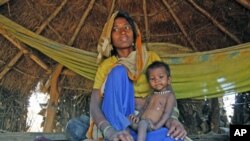
The World Health Organization (WHO) is calling for action to fight all forms of malnutrition, including under-nutrition and obesity, which affect hundreds of millions of people worldwide. More than 60 world nutrition experts are meeting at WHO headquarters this week to revise guidelines and to identify solutions to tackle this growing problem.
WHO says malnutrition globally accounts for 11 percent of all diseases and causes long-term poor health and disability. It says malnutrition causes stunted growth and wasting (being extremely thin) in nearly 300 million children.
It says nearly 4 million children die each year from nutritional risks, including underweight, and vitamin and mineral deficiency, particularly of vitamin A, iron, iodine and zinc.
While lack of food can lead to serious health problems, too much food can have the same affect. WHO’s Director of Nutrition for Health and Development, Francesco Branca, says 43 million children under age five are overweight.
"We are seeing that often we have in the same countries, at the same time, the presence of under-nutrition and overweight. We are seeing that this increase in overweight is becoming, in fact, a problem in developing countries. We have the greatest increase in overweight in Africa, particularly North Africa, and we now can say that perhaps the proportion of the number of children who are overweight is actually larger in developing countries than in developed countries," said Branca.
The World Health Organization reports about one-third of the 1.5 billion overweight people in the world are obese. It says 35 million of the 43 million overweight children are in developing countries. The largest numbers are in Asia, but it notes the fastest growth rates are in Africa.
WHO says today’s children are becoming overweight because they are more sedentary than in the past. Simply put, they are eating more than they need.
It says the highly refined, processed high-energy density food available in rich countries also is widely available in poor countries. And, these foods are high in sugar and fat content.
Professor of nutrition at Cornell University, Rebecca Stoltzfus, said the overweight and obesity epidemics are now present in every country in the world. She said the conditions of vitamin and mineral deficiencies, and being overweight and obese, are related in multiple ways.
"The kinds of diets that lead children to become overweight - the high sugar, high fat diets - tend to be relatively low in essential vitamins and minerals. But, secondly, there is evidence emerging that the condition of overweight or obesity also changes one’s metabolism of key minerals, such as iron, so that obese individuals do not absorb and metabolize iron normally," said Stoltzfus.
Stoltzfus said underweight in women and children is responsible for more premature deaths and disability than any other preventable risk factor - more than unsafe sex, more than tobacco use and more than overweight.
WHO says child overweight and obesity, though, also can lead to serious health consequences, including early onset of diabetes, high blood pressure, heart disease and certain cancers.
WHO: Epidemics of Underweight and Overweight Growing
- By Lisa Schlein