This is Part Three of a five-part series on Eritrea Today
Continue to Parts: 1 / 2 / 3 / 4 / 5
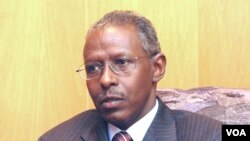
A political advisor to Eritrea President Isaias Afewerki says the Horn of Africa country rejects any forms of international aid, and only seeks strategic investment partnerships.
Yemane Gebreab, who is also head of political affairs at the People's Front for Democracy and Justice (PFDJ), said Eritrea has a policy of self-reliance that sharply opposes international food or financial assistance.
“Our experience and the experience of the developing countries is that aid is disabling, debilitating [and] prevents people from making use of their resources, from tapping into their own potential, [and] from exercising their own minds, from achieving independence of thought and policies,” said Gebreab.
“Aid has not worked [and] to some extent aid works for the countries that are said to be providing [it]. It’s a means of influencing African countries, of entering African markets. It hasn’t worked for Africa and for the developing world.”
Gebreab cited the conclusion of a 2011 conference in the southern port city of Busan, South Korea that examined the effectiveness of aid over the years as further proof that international assistance to developing countries has failed to yield positive results.
He said since its independence in 1991, Eritrea has mobilizing its resources to build the country, despite serious security and logistical challenges.
Gebreab underscored his government’s policy of self-reliance in spite of what he described as the country’s scant natural resources.
“[What] a policy of avoiding aid dependency, mobilizing our own resources has done is that it has enabled us to build local national capacity. It has enabled us to build very strong relations with our population, because at the end of the day we will have to depend on our people…So politically as well as economically, it has been a success,” said Gebreab.
He said African countries endowed with "rich natural resources" could learn from the Eritrea’s example rather than depend on foreign aid.
“Sometimes we look at them and we wonder why a country that has an income of millions of dollars from its natural resources has to wait for 10-20 million dollars of aid from any country in the world. We really don’t see any need for it,” he said.
Gebreab said many African nations have come to a consensus that international food or financial assistance over the years has often undermined the resourcefulness of developing nations. He said some Africans who financially benefit from external aid will continue to resist the idea that the continent does not need it.
Gebreab said with proper management, Africa can wean itself away from dependency.
“People are coming to the conclusion that Africa has within itself the capacity to develop its own economy. When we talk about self-reliance, we are not talking about [isolating] ourselves [and not interacting] with others. We develop our economies on our own in order to become global actors,” said Gebreab.
“So, I think we need to change the paradigm, and we need to tell ourselves that we can do it on our own. We are the ones who are transferring money from Africa to the north. It’s not vice versa.”
Gebreab called on African countries to invest in each other as well as abroad.
Human Rights Watch says since independence, the country has received modest amounts of financial support from China, the United Arab Emirates, Iran, Qatar and until the overthrow of Muammar Gadhafi, Libya.
HRW says Asmara continues to accept UN funding for health, sanitation and safe-water projects, though it has ended its relationship with the World Bank.
The U.S. State Department web page notes that the Eritrean government requested an end to bilateral assistance from the U.S. However, it notes U.S. interests include encouraging Eritrea to contribute to regional stability, and to develop a democratic political culture and promote economic reform.
Continue to Parts: 1 / 2 / 3 / 4 / 5
A political advisor to Eritrea President Isaias Afewerki says the Horn of Africa country rejects any forms of international aid, and only seeks strategic investment partnerships.
Yemane Gebreab, who is also head of political affairs at the People's Front for Democracy and Justice (PFDJ), said Eritrea has a policy of self-reliance that sharply opposes international food or financial assistance.
“Our experience and the experience of the developing countries is that aid is disabling, debilitating [and] prevents people from making use of their resources, from tapping into their own potential, [and] from exercising their own minds, from achieving independence of thought and policies,” said Gebreab.
“Aid has not worked [and] to some extent aid works for the countries that are said to be providing [it]. It’s a means of influencing African countries, of entering African markets. It hasn’t worked for Africa and for the developing world.”
Gebreab cited the conclusion of a 2011 conference in the southern port city of Busan, South Korea that examined the effectiveness of aid over the years as further proof that international assistance to developing countries has failed to yield positive results.
He said since its independence in 1991, Eritrea has mobilizing its resources to build the country, despite serious security and logistical challenges.
Gebreab underscored his government’s policy of self-reliance in spite of what he described as the country’s scant natural resources.
“[What] a policy of avoiding aid dependency, mobilizing our own resources has done is that it has enabled us to build local national capacity. It has enabled us to build very strong relations with our population, because at the end of the day we will have to depend on our people…So politically as well as economically, it has been a success,” said Gebreab.
He said African countries endowed with "rich natural resources" could learn from the Eritrea’s example rather than depend on foreign aid.
“Sometimes we look at them and we wonder why a country that has an income of millions of dollars from its natural resources has to wait for 10-20 million dollars of aid from any country in the world. We really don’t see any need for it,” he said.
Gebreab said many African nations have come to a consensus that international food or financial assistance over the years has often undermined the resourcefulness of developing nations. He said some Africans who financially benefit from external aid will continue to resist the idea that the continent does not need it.
Gebreab said with proper management, Africa can wean itself away from dependency.
“People are coming to the conclusion that Africa has within itself the capacity to develop its own economy. When we talk about self-reliance, we are not talking about [isolating] ourselves [and not interacting] with others. We develop our economies on our own in order to become global actors,” said Gebreab.
“So, I think we need to change the paradigm, and we need to tell ourselves that we can do it on our own. We are the ones who are transferring money from Africa to the north. It’s not vice versa.”
Gebreab called on African countries to invest in each other as well as abroad.
Human Rights Watch says since independence, the country has received modest amounts of financial support from China, the United Arab Emirates, Iran, Qatar and until the overthrow of Muammar Gadhafi, Libya.
HRW says Asmara continues to accept UN funding for health, sanitation and safe-water projects, though it has ended its relationship with the World Bank.
The U.S. State Department web page notes that the Eritrean government requested an end to bilateral assistance from the U.S. However, it notes U.S. interests include encouraging Eritrea to contribute to regional stability, and to develop a democratic political culture and promote economic reform.