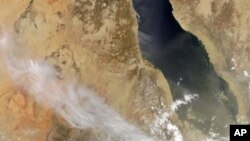
A volcanic eruption in Eritrea has sent a plume of ash across the Horn of Africa, disrupting airline schedules and sparking health concerns.
Satellite photos show a column of ash rising from the long-dormant Nabro volcano in far southeastern Eritrea, near its border with Ethiopia and the city-state of Djibouti. The eruption is also about 100 kilometers from the coast of Yemen, just across the mouth of the Red Sea.
A photo posted on the website earthobservatory.nasa.gov shows the ash plume spreading westward toward Sudan.
The ash cloud prompted U.S. Secretary of State Hillary Clinton to cut short a visit to Ethiopia, where she addressed the African Union Monday. It has also disrupted commercial aviation. Several major airlines cancelled flights to destinations in the region.
Ethiopian Airlines spokesman Getachew Tesfa said Addis Ababa’s Bole airport remains open, and only Ethiopian's flights to northern parts of the country and Djibouti have been cancelled.
"Currently flights are operating from Bole airport. It’s only local destinations and these regional Djibouti, Djibouti the airport is closed because of this, so as soon as they tell us it is clear, then we will continue. The rest of the flights are still working," Getachew said.
An Ethiopian Civil Aviation Authority official says conditions are being constantly monitored to determine flight safety.
Internet bloggers on Tuesday reported that as much as one millimeter of ash dust has accumulated on surfaces at some locations in northern Ethiopia and Djibouti, raising questions about the health risk.
But Dr. Olle Liungman, a Swedish physician in Addis Ababa who has been monitoring the ash cloud’s movement, said the immediate danger from inhaling the dust is minimal.
"As a general attitude toward that cloud, it can be [come] more and it can go up and be much bigger than it is now, but as it is now, it is not a major thing," Liungman said.
The Nabro volcano was thought to have been extinct, but it rumbled to life Sunday night after a serie s of minor earthquakes. The region, known as the Afar Triangle, sits along a geologic fault known as the East African Rift, where the continent is slowly being pulled apart by tectonic plate movements.
Geologists say at its current rate of expansion, the Great Rift Valley will grow into an ocean, splitting Africa in two within a few million years.
Eritrea Volcano Disrupts East Africa Air Travel