


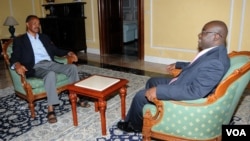
Eritrean President Isaias Afewerki calls the country’s development drive over two decades of independence “a success story.”
“We have achieved a lot, and our culture has helped us a lot to create an environment for sustainable development,” he told VOA in an exclusive interview ahead of the 21st anniversary of his country’s independence on May 24.
“Our main objective for the last 21 years was to create an environment for real independence… We have put the flag we took 21 years ago on a very solid ground,” said Isaias. The major achievement, he emphasized, was the creation of a “solid foundation” for Eritrea’s development.
Speaking from the presidential palace in Eritrea’s capital, Asmara, Mr. Isaias said his country was faced with what he called “subjective internal and external challenges” shortly after gaining independence. He said the country’s leadership had to struggle to meet public demands for development after decades of protracted fighting. Among the top tasks were ensuring food security, building up destroyed infrastructure, as well as providing safe drinking water and improved transportation.
The real challenge, he said, was resources: “You may aspire to achieve some goals, but definitely you need some resources to do that” he said, adding, “that was really serious for us.”
“The external challenge was so many problems – regional, international problems even in terms of implementing programs. The disparity of our approach to addressing issues, for example, do we go for [foreign] aid to build our economy and build a capacity for sustainable growth, or find our own ways of doing that... [this], in spite of the security challenge we have faced over the last 15 or so years, which has been a learning experience for us.”
Aid and development
Eritrea’s economy has grown, despite poor relations with Ethiopia, once a primary trading partner. The International Monetary Fund’s latest World Economic Outlook predicted Eritrea’s GDP to grow over seven percent this year.
Health care has also improved. The UN Development Program says Eritrea is one of four African countries likely to reduce maternal mortality by three-quarters by 2015.
For government supporters, this is evidence that the administration has been able to meet the needs of its citizens, including improved infrastructure, food security, and transportation, without any foreign “handouts.” President Isaias said with improved capacity building, the country is working to break what he called the cycle of over-dependence on aid.
Human Rights Watch says since independence, the country has received modest amounts of financial support from China, the United Arab Emirates, Iran, Qatar and until the overthrow of Muammar Gadhafi, Libya.
HRW says Asmara continues to accept UN funding for health, sanitation and safe-water projects, though it has ended its relationship with the World Bank.
The U.S. State Department web page notes that the Eritrean government requested an end to bilateral assistance from the U.S. However, it notes U.S. interests include encouraging Eritrea to contribute to regional stability, and to develop a democratic political culture and promote economic reform.
Criticisms
Critics say the ideals that galvanized Eritreans to fight for their freedom, which ultimately led to the country’s independence 21 years ago, are yet to be realized.
Last year, Assistant Secretary of State, Johnnie Carson, called Eritrea, “a repressive regime [that] fails to provide data on the humanitarian needs of its own people.” He called on the government to cooperate with the UN agencies and other international organizations to address hunger.
Human Rights Watch says in 2009, Isaias told the UN Children’s fund that Eritrea was suffering from famine though the government officially denied food shortages.
But Isaias disagrees with these criticisms.
“This is an insult to my intelligence. I am a product of the process I lived, and I have developed my own thinking in these practical processes in that environment…These are stereotypes for people who live in the unreal world who think other people don’t have heads and don’t think. They categorize people in groups,” he said.
He said the experience and values Eritreans have shared over the years binds citizens together.
Priority is development, not democracy
Observers say the suspension of Eritrea’s constitution thwarted the country’s march towards democracy. The document, which was introduced 15 years ago and ratified in 2002, has not been fully implemented. The president exercises legislative as well as executive powers.
President Isaias attributed the suspension of the constitution to what he calls external interference. He also stated that embracing the “so-called” tenets of democracy is not a priority of Eritrea. He said development is the government’s priority, not democracy.
“Because of these continuous external interventions, we have to do first things first... It’s not an immediate concern at the moment…I will say our number one priority on the level of the continent is to free ourselves from trying to show and please these guys who are taking us for puppet, toys, or masters of today,” he said.
Isaias said the reality of the country dictates what needs to be done, irrespective of criticisms that he wants to be president for life.
“The same people who are making the lives of these people and the people in Ethiopia difficult, who are trying to find pretext and try to raise issues irrelevant so as to distract us from focusing on the real issues. My person is not an issue…it’s more of an issue for the opportunities of the people of this country and the people of our neighbors. That’s the real issue,” continued Mr. Isaias.
“These are part of the agenda. They have in their basket a number of issues they try to continue to harass and border us on these issues so that we will be distracted from doing our job…If you try to distract me from real issues, I will say you are wasting your time.”
Press freedom
Observers say the Eritrea government has been repressive and brutal, clamping down on dissent, including the imprisoning without trial of journalists critical of the administration.
Human Rights Watch says in Eritrea, up to 10,000 may be jailed for political dissent, including military service evaders and deserters. It says the private press was banned over 10 years ago, and says over 20 prominent journalists and critics have been held since then incommunicado.
But Isaias said the accusations are non-issues, stating that his government is not interested in blocking people from expressing their views. He said Eritreans at home or abroad are the best judges of the situation on the ground. He said those opposed to his government seem to have easy media access in which to criticize the administration abroad.
He said his government reserves the right to protect its citizens, especially when foreigners give money to Eritreans to destabilize the country.
“When a foreign intelligence agency is buying hearts with money – recruiting people to do sabotage – definitely national security becomes an issue. That is not an option… Any attempt from outside to sabotage or do harm to the people of this country, I have a responsibility to take action against those who want to harm the people, not against those who are speaking. Those who are speaking can go ahead and make the loud noise. People are immune now,” he said.
Mr. Isaias said his government has now chosen to ignore Eritreans, in the country as well as in the Diaspora, who he said collect payments from foreign intelligence agencies to misrepresent the country.
Eritrea and Ethiopia relations
Asmara and Addis Ababa continue to engage in frosty diplomatic and bilateral relations, despite, according to observers, shared goals to benefit the lives of their peoples.
The two countries have been involved in a border dispute, despite a United Nations-backed arbitration commission that awarded the Badme area to Eritrea. Asmara has often criticized Addis Ababa for its continued refusal to implement the border commission’s ruling.
President Isaias said the two neighboring countries could have resolved their differences devoid of what he called external influence and interference in the region.
“We could have fostered solid relations with Ethiopia…What concerns anyone is the opportunity we have lost. And who has created this crisis? It’s not the government of Ethiopia alone. The government of Ethiopia because of its internal problems, may have tried to benefit from this crisis,” he said.
In March, Ethiopia attacked Eritrean army outposts along the border. Addis Ababa said the assault was in retaliation for the training and support given by Asmara to subversives. Eritrea says the US knew of the attacks, an accusation denied by US officials.
“The problem is for the United States government that has intervened continually, without any justifiable reason, legal or political, to keep us hostage to this crisis and to this border conflict… We are saying leave us alone. We would like to build on our future without your interference and this border problem is resolved. ”
Regional cooperation
Eritrea suspended its membership in the Intergovernmental Authority on Development, a group of six eastern African countries focused on drought control and development initiatives, after raising concerns about Ethiopia’s role in Somalia. Asmara has since reapplied to have its membership reinstated.
The sub-regional bloc has been making efforts to resolve security challenges in the area including cross border violence allegedly perpetrated by the Somali-based hardline Islamic insurgent group, al-Shabab.
In his interview with VOA, President Isaias called for a collaborative effort among IGAD member states to ensure peace and stability in the Horn of Africa region. He vowed Eritrea will continue making its contributions to help IGAD realize its aspirations, which he said could lead to strengthened bilateral and diplomatic relations among member states.
“Imagine an ideal situation, where a group of heads of state discuss among themselves… and they have arrived at a consensus, through an exhaustive and constructive discussions through a structure and consolidate their ideas in a document and finally creating an organizational set up for that. I think this is the only healthy way for us to regain lost opportunities and look forward to a promising future,” he said.
Mr. Isaias called on other heads of states not to be bogged down by what he called endless conflicts.
“We have achieved a lot, and our culture has helped us a lot to create an environment for sustainable development,” he told VOA in an exclusive interview ahead of the 21st anniversary of his country’s independence on May 24.

“Our main objective for the last 21 years was to create an environment for real independence… We have put the flag we took 21 years ago on a very solid ground,” said Isaias. The major achievement, he emphasized, was the creation of a “solid foundation” for Eritrea’s development.
Speaking from the presidential palace in Eritrea’s capital, Asmara, Mr. Isaias said his country was faced with what he called “subjective internal and external challenges” shortly after gaining independence. He said the country’s leadership had to struggle to meet public demands for development after decades of protracted fighting. Among the top tasks were ensuring food security, building up destroyed infrastructure, as well as providing safe drinking water and improved transportation.
The real challenge, he said, was resources: “You may aspire to achieve some goals, but definitely you need some resources to do that” he said, adding, “that was really serious for us.”
“The external challenge was so many problems – regional, international problems even in terms of implementing programs. The disparity of our approach to addressing issues, for example, do we go for [foreign] aid to build our economy and build a capacity for sustainable growth, or find our own ways of doing that... [this], in spite of the security challenge we have faced over the last 15 or so years, which has been a learning experience for us.”
Aid and development
Eritrea’s economy has grown, despite poor relations with Ethiopia, once a primary trading partner. The International Monetary Fund’s latest World Economic Outlook predicted Eritrea’s GDP to grow over seven percent this year.
Health care has also improved. The UN Development Program says Eritrea is one of four African countries likely to reduce maternal mortality by three-quarters by 2015.
For government supporters, this is evidence that the administration has been able to meet the needs of its citizens, including improved infrastructure, food security, and transportation, without any foreign “handouts.” President Isaias said with improved capacity building, the country is working to break what he called the cycle of over-dependence on aid.
Human Rights Watch says since independence, the country has received modest amounts of financial support from China, the United Arab Emirates, Iran, Qatar and until the overthrow of Muammar Gadhafi, Libya.
HRW says Asmara continues to accept UN funding for health, sanitation and safe-water projects, though it has ended its relationship with the World Bank.
The U.S. State Department web page notes that the Eritrean government requested an end to bilateral assistance from the U.S. However, it notes U.S. interests include encouraging Eritrea to contribute to regional stability, and to develop a democratic political culture and promote economic reform.
Criticisms
Critics say the ideals that galvanized Eritreans to fight for their freedom, which ultimately led to the country’s independence 21 years ago, are yet to be realized.
Last year, Assistant Secretary of State, Johnnie Carson, called Eritrea, “a repressive regime [that] fails to provide data on the humanitarian needs of its own people.” He called on the government to cooperate with the UN agencies and other international organizations to address hunger.
Human Rights Watch says in 2009, Isaias told the UN Children’s fund that Eritrea was suffering from famine though the government officially denied food shortages.
But Isaias disagrees with these criticisms.
“This is an insult to my intelligence. I am a product of the process I lived, and I have developed my own thinking in these practical processes in that environment…These are stereotypes for people who live in the unreal world who think other people don’t have heads and don’t think. They categorize people in groups,” he said.
He said the experience and values Eritreans have shared over the years binds citizens together.
Priority is development, not democracy
Observers say the suspension of Eritrea’s constitution thwarted the country’s march towards democracy. The document, which was introduced 15 years ago and ratified in 2002, has not been fully implemented. The president exercises legislative as well as executive powers.
President Isaias attributed the suspension of the constitution to what he calls external interference. He also stated that embracing the “so-called” tenets of democracy is not a priority of Eritrea. He said development is the government’s priority, not democracy.
“Because of these continuous external interventions, we have to do first things first... It’s not an immediate concern at the moment…I will say our number one priority on the level of the continent is to free ourselves from trying to show and please these guys who are taking us for puppet, toys, or masters of today,” he said.
Isaias said the reality of the country dictates what needs to be done, irrespective of criticisms that he wants to be president for life.
“The same people who are making the lives of these people and the people in Ethiopia difficult, who are trying to find pretext and try to raise issues irrelevant so as to distract us from focusing on the real issues. My person is not an issue…it’s more of an issue for the opportunities of the people of this country and the people of our neighbors. That’s the real issue,” continued Mr. Isaias.
“These are part of the agenda. They have in their basket a number of issues they try to continue to harass and border us on these issues so that we will be distracted from doing our job…If you try to distract me from real issues, I will say you are wasting your time.”
Press freedom
Observers say the Eritrea government has been repressive and brutal, clamping down on dissent, including the imprisoning without trial of journalists critical of the administration.
Human Rights Watch says in Eritrea, up to 10,000 may be jailed for political dissent, including military service evaders and deserters. It says the private press was banned over 10 years ago, and says over 20 prominent journalists and critics have been held since then incommunicado.
But Isaias said the accusations are non-issues, stating that his government is not interested in blocking people from expressing their views. He said Eritreans at home or abroad are the best judges of the situation on the ground. He said those opposed to his government seem to have easy media access in which to criticize the administration abroad.
He said his government reserves the right to protect its citizens, especially when foreigners give money to Eritreans to destabilize the country.
“When a foreign intelligence agency is buying hearts with money – recruiting people to do sabotage – definitely national security becomes an issue. That is not an option… Any attempt from outside to sabotage or do harm to the people of this country, I have a responsibility to take action against those who want to harm the people, not against those who are speaking. Those who are speaking can go ahead and make the loud noise. People are immune now,” he said.
Mr. Isaias said his government has now chosen to ignore Eritreans, in the country as well as in the Diaspora, who he said collect payments from foreign intelligence agencies to misrepresent the country.
Eritrea and Ethiopia relations
Asmara and Addis Ababa continue to engage in frosty diplomatic and bilateral relations, despite, according to observers, shared goals to benefit the lives of their peoples.
The two countries have been involved in a border dispute, despite a United Nations-backed arbitration commission that awarded the Badme area to Eritrea. Asmara has often criticized Addis Ababa for its continued refusal to implement the border commission’s ruling.
President Isaias said the two neighboring countries could have resolved their differences devoid of what he called external influence and interference in the region.
“We could have fostered solid relations with Ethiopia…What concerns anyone is the opportunity we have lost. And who has created this crisis? It’s not the government of Ethiopia alone. The government of Ethiopia because of its internal problems, may have tried to benefit from this crisis,” he said.
In March, Ethiopia attacked Eritrean army outposts along the border. Addis Ababa said the assault was in retaliation for the training and support given by Asmara to subversives. Eritrea says the US knew of the attacks, an accusation denied by US officials.
“The problem is for the United States government that has intervened continually, without any justifiable reason, legal or political, to keep us hostage to this crisis and to this border conflict… We are saying leave us alone. We would like to build on our future without your interference and this border problem is resolved. ”
Regional cooperation
Eritrea suspended its membership in the Intergovernmental Authority on Development, a group of six eastern African countries focused on drought control and development initiatives, after raising concerns about Ethiopia’s role in Somalia. Asmara has since reapplied to have its membership reinstated.
The sub-regional bloc has been making efforts to resolve security challenges in the area including cross border violence allegedly perpetrated by the Somali-based hardline Islamic insurgent group, al-Shabab.
In his interview with VOA, President Isaias called for a collaborative effort among IGAD member states to ensure peace and stability in the Horn of Africa region. He vowed Eritrea will continue making its contributions to help IGAD realize its aspirations, which he said could lead to strengthened bilateral and diplomatic relations among member states.
“Imagine an ideal situation, where a group of heads of state discuss among themselves… and they have arrived at a consensus, through an exhaustive and constructive discussions through a structure and consolidate their ideas in a document and finally creating an organizational set up for that. I think this is the only healthy way for us to regain lost opportunities and look forward to a promising future,” he said.
Mr. Isaias called on other heads of states not to be bogged down by what he called endless conflicts.