



News / USA

Escaped Slaves Followed the North Star to Freedom

Recreating the escape route to northern states and Canada for fleeing slaves

Follow the North Star participants learn about slavery at a re-enacted outdoor auction.

Multimedia

Audio
TEXT SIZE - +

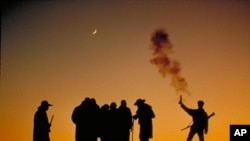
"History by immersion," is how the Conner Prairie interactive history park outside Indianapolis, Indiana, describes a program about a perilous journey to freedom endured by escaped southern slaves during the 19th-century.  It is an unforgettable walk in the woods that has special meaning during February, which is Black History Month in the United States.

The program is called Follow the North Star.  The name is adapted from an old American Negro spiritual song, Follow the Drinking Gourd.
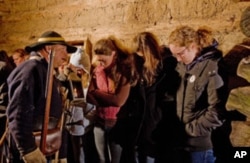
Their new owner speaks harshly to participants before they escape and make a run for freedom.

In the years before and during the U.S. Civil War of the 1860s, escaped slaves fled northward, hiding by day and moving furtively at night.  Often their only guide was Polaris, the North Star, which they found by tracing the handle of the Big Dipper constellation, or Drinking Gourd.  But even when they crossed the Ohio and Potomac Rivers, they were by no means safe.  Slave catchers scoured free northern states like Indiana, looking for runaways.

That's the story that's re-created, ultra-realistically, at Connor Prairie.  Follow the North Star is held outside and at night and in all kinds of weather.  Participants of all races play the part of blacks who are rounded up, divided by sex into what the slavers call bucks and breeders, and sold like cattle at auction.

With help from white Quakers and free blacks, the fugitives escape and seek safe houses along what came to be called the Underground Railroad.  A high-school girl who says she learned more about Civil War history there than she could in any classroom summed up the experience.  "It was really intense," she said, adding, "I felt like an animal."

At the end of the program, each person learns his or her fate as a fugitive.  Some are captured.  Others, had they been actual slaves, would have been among those killed.  Many participants spend the entire hour and a half in tears.  For sure, just as in real life almost two centuries ago, not every runaway slave makes it to Canada and certain freedom.

You May Like

Experts Weigh In on Challenges of Closing Guantanamo Prison

Former chief military prosecutor at Guantanamo delivers petition to White House with more than 370,000 signatures, demanding facility be closed down immediately More

Karzai to Discuss Enhancing Defense Ties with India

Afghanistan looking for more military aid as it prepares for withdrawal of NATO forces by next year More

India, China Pledge to Overcome Border Tensions

Indian prime minister and Chinese premier attempt to move past tense standoff in the Himalayas during Delhi talks More

Burmese President Opens US Visit with VOA Town Hall Meeting

Ahead of his meeting with President Obama Monday, Thein Sein answered questions on human rights and economic development in his country More

This forum has been closed.
Comments
     
There are no comments in this forum. Be first and add one

Featured Videos

Your JavaScript is turned off or you have an old version of Adobe's Flash Player. Get the latest Flash player.
Video

Video US Oil Surge Could Impact Mideast Geopolitics

The United States will account for a third of new oil supplies over the next five years, and will become energy self-sufficient in 20 years, according to a new report by the Paris-based International Energy Agency (IEA). Although U.S. oil imports from Arab Gulf countries increased last year, analysts predict the U.S. will lose its dependence on Middle East imports, which is expected to have a huge impact on international relations and the balance of power. VOA's Henry Ridgewell reports.