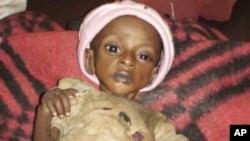
Ethiopia’s government estimates 2.8 million people will need emergency food aid this year, down sharply from a year ago. Nearly 40 percent of the needy are reported in the sparsely populated, but insurgency-wracked Somali region.
The good news is that the number of Ethiopians in danger has dropped from 5.2 million a year ago to an estimated 2.8 million this year.
Ethiopia’s State Minister for Agriculture Mitiku Kassa credits two things for the improvement. One is good weather, which produced a bumper crop in a country where four out of five people earn their living from agriculture. The other is food aid, which is believed to have reached 12 million of Ethiopia’s 80 million people last year.
But there are worrisome signs. Sitting alongside Mitiku at a news conference, U.N. Humanitarian Coordinator for Ethiopia Eugene Owusu said the 2.8-million figure tells only part of the story.
"Two-point-eight-million still require relief food assistance," said Owusu. "And we also know an additional 956,000 require targeted supplementary feeding. An estimated 107,000 children may continue to require treatment for severe acute malnutrition, and 3.3 million people will require screening for more nutrition and Vitamin A supplementation."
Another 7.8-million Ethiopians receive food or cash under a preventive program known as the Productive Safety Net.
Owusu said millions of Ethiopians are also at risk of malaria, measles and Acute Watery Diarrhea, which in other places in known as cholera. And he said the onset of a drought in some regions, which forced officials to revise their estimates upward in recent months, is likely to continue.
"Deteriorating food security conditions recorded in the December assessment will only deepen if the drought prevails through the first half of the year, as the latest forecast of the National Meteorological Agency indicates it is likely to do," he added.
The government report indicates almost 40 percent of those nutritionally at risk are in the Somali region, home to less than six percent of the country’s population. Ethiopian troops are engaged in a counter-insurgency operation there against indigenous rebels of the Ogaden National Liberation Force.
The group, in e-mail messages, has accused the government of ethnic cleansing and blocking food aid deliveries to rebel-held areas. The government strongly denies the claims and says the rebel movement is dying, but restricts access to donor groups trying to monitor aid distribution.
State Minister Mitiku says the area of restricted movement includes only a few districts, known as woredas.
"Currently there are only nine woredas that need clearance from the respective authorities to move in these zones," said Mitiku. "The rest, 43 out of 52 are free for movements by the U.N. agencies [and] the NGO agencies who are working in the Somali region."
But aid community representatives are pushing for greater access to the insurgency zone. U.N. aid coordinator Owusu says local officials often block access to humanitarian workers even in a usually quiet woreda.
"There are instances of localized restrictions, depending on the mood of local officials," said Owusu. "The major restrictions are largely in those high security risk woredas, but my point of departure with the minister would be, even in the other woredas, there are instances of localized restrictions that might not be as stringent as what we experience in the nine high security risk woredas."
The head of the British government’s Department for International Development office in Ethiopia, Howard Taylor, says aid agencies are often frustrated in attempts to ensure food is reaching the intended recipients.
"It gets better and it gets worse," said Taylor. "It is not a constant. Sometimes the food is getting through and sometimes we know it is not."
Taylor and humanitarian coordinator Owusu say while monitoring aid deliveries is easier than in past years, they are pushing for more fruitful discussions with security authorities to find a way donors can be certain people who need food and water in the insurgency zone are able to get it.
Ethiopia Says 2.8 Million People Need Emergency Food Aid