



Continue to Parts: 1 / 2 / 3 / 4 / 5 / 6 / 7/ 8 / 9 / 10 / 11 /12
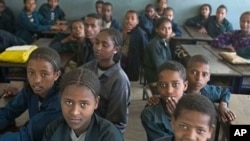
Ethiopia, one of Africa's poorest countries, is among the few on track to achieve the goal of universal primary education by 2015. Our correspondent in Addis Ababa, reports on how, according to analysts, an otherwise repressive government is winning praise for its campaign to bring learning to the people.
“I can say we made [an] education revolution in the history of this country," said Petros Woldegiorgis.
Education Ministry Spokesman Petros Woldegiorgis tells how Ethiopia, which had fewer than 2,000 primary schools 15 years ago now has 28,0000, and is on the verge of providing access to education for all of its 20 million school age children.
“We gave great priority for education," he said. "Why we are doing this is we know the value of education. Therefore, the huge investment was made for [the] education sector by this government.”
Development aid experts say Ethiopia has devoted as much as one quarter of all public expenditures to schools during the past few years. This commitment is prompting international donors to pump in an estimated $150 million a year to support the effort.
The World Bank's senior education specialist in Ethiopia, Rajendra Joshi, says the investment is beginning to pay off.
“If we look at the progress toward achieving universal primary education from 2003 to 2009-10, it increased by 40 percentage points, which is huge," said Joshi. "Ethiopia at the beginning of the '90s used to be one of the worst countries in terms of participation rate. Now participation rate in primary education is 86 percent - grades one to eight.”
But getting children into classrooms is the easy part. The challenge is bringing them up to basic literacy levels.
The rapid growth in the number of schools has created a severe shortage of qualified teachers. In most classrooms, there are no books. Surveys indicate that many children leave school without learning to read.
The nearly $1 billion a year in U.S. aid to Ethiopia includes a five-year $100 million commitment for education. USAID's chief education officer in Ethiopia, Allyson Wainer, says the plan is to bring reading skills to 15 million students.
"Currently the books don't exist, and the curriculum doesn't exist from a reading perspective, and that's what we'll be developing in the coming year," said Wainer. "And the government's taking it very seriously. And we're taking it extremely seriously in that our goal is to contribute to the literacy rate and the learning of children in grades one, two and three, so they have the skills they need to be literate."
The program also aims to end the literacy gender gap. Ethiopian girls traditionally have lagged far behind boys in school attendance and achievement.
Wainer says neighborhood schools should remove all obstacles to educating girls.
"Knowing that girls can safely get to school because the distances is not overwhelming, and that girls can access a safe school, hopefully a separate latrine facility for boys and girls, teachers who have been trained on the needs of girls, and girls were the ones who generally weren't going to school as well," she said.
In its quest to meet the goal of education for all, Ethiopia has also established mobile classrooms to travel with nomadic herders who roam the countryside in search of grazing land for their animals.
Education Ministry Spokesman Petros Woldegiorgis says being poor should not be a nation's excuse for failing to make education accessible to all of its citizens.