


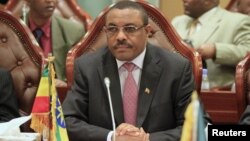
Ethiopia hopes to witness its first peaceful transition in recent history, once the new prime minister is sworn in. Two weeks after the death of former leader Meles Zenawi, it is still unclear when Deputy Prime Minister Hailemariam Desalegn might take the oath of office as the country's new leader.
The swearing in ceremony for Minister of Foreign Affairs and Deputy Prime Minister Hailemariam Deasalgne was scheduled two days after the passing of Mr. Meles, but the government felt the nation needed more time to mourn his death.
Opposition Party EDP, Ethiopia’s Democratic Party, is urging the government move forward with officially making Hailemariam the prime minister as soon as possible.
“What we have seen in case of other countries like Ghana and Malawi, what they did was as soon as possible they confirmed the reappointment or election of another president before proceeding to the other matters," says Mesfin Mengistu, the EDP secretary general. "Here what we have seen is contrary to that."
There has been some confusion about the legal status of Hailemariam -- whether he is acting prime minister or still deputy prime minister. Mesfin says there is an important difference:
“At this particularly, I think the DM is not acting PM," he says. "It was pronounced like that, but later on it was taken back and now the person in charge of the country is the DPM, not the acting PM. That implies to us the person who is ruling the country has no fully placed power to rule the country. That entails a power vacuum which we think that should be filled as soon as possible.”
Government officials could not be reached for comment. However, government spokesperson Bereket Simon had said, after the passing of Meles, that Hailemariam will be the new prime minister until the elections in 2015.
“The constitutional proceedings allow us to continue with the deputy prime minister, acting prime minister for now and then he will take off in parliament,” said Simon.
Hailemariam being sworn in as new prime minister would open a new chapter for Ethiopia, with the transfer of power being occurring in a peaceful manner.
Ruling party EPRDF seized power in 1991, after a 17-year guerilla fight that ousted the military junta of Mengistu Haile Mariam. Mr. Mengistu came to power in 1974 after the Ethiopian revolution had overthrown long-time emperor Haile Selassie.
Patrick Gilkes, a writer of historical books on Ethiopia, says this peaceful transition is a major step for Ethiopia and its violent history:
“It is very significant in many ways, because it illustrates how far Ethiopia [gone]," says Gilkes. "It now has an administrative structure that functions. The developments over the last 20-odd years have been very important in turning Ethiopia into a functional federal structural system.
"There are governments in the regions which have their own parliaments and they have their own administrative structures as well," he continues. "This means that you have built in a structure that can survive upsets and problems and shocks."
Independent political analyst Medhane Tadesse says the transition is different from Ethiopia’s history, but does not see it as a transition in the true sense of the word.
“This is not a kind of transition from a ruling party to an opposition party," says Medhane. "There is no powerful group to challenge the successor, both within the establishment and outside. Ethiopia is not making [a] real political transition."
It remains to be seen if this transition will permanently end Ethiopia’s violent history. Although most Ethiopians desire a smooth transition, Medhane says that changes need to be made to remain peaceful in the future.
“Unless they do political reforms and the state delivers in every way, not only security, not only development, but political and civil rights, then it will be a problem,” adds Medhane.
Hailemariam Desalegn is expected to be formally appointed later this week. However, there has been no sign that the government plans on political reforms. Government officials have repeatedly said they will continue the policies of the Meles.
The swearing in ceremony for Minister of Foreign Affairs and Deputy Prime Minister Hailemariam Deasalgne was scheduled two days after the passing of Mr. Meles, but the government felt the nation needed more time to mourn his death.
Opposition Party EDP, Ethiopia’s Democratic Party, is urging the government move forward with officially making Hailemariam the prime minister as soon as possible.
“What we have seen in case of other countries like Ghana and Malawi, what they did was as soon as possible they confirmed the reappointment or election of another president before proceeding to the other matters," says Mesfin Mengistu, the EDP secretary general. "Here what we have seen is contrary to that."
There has been some confusion about the legal status of Hailemariam -- whether he is acting prime minister or still deputy prime minister. Mesfin says there is an important difference:
“At this particularly, I think the DM is not acting PM," he says. "It was pronounced like that, but later on it was taken back and now the person in charge of the country is the DPM, not the acting PM. That implies to us the person who is ruling the country has no fully placed power to rule the country. That entails a power vacuum which we think that should be filled as soon as possible.”
Government officials could not be reached for comment. However, government spokesperson Bereket Simon had said, after the passing of Meles, that Hailemariam will be the new prime minister until the elections in 2015.
“The constitutional proceedings allow us to continue with the deputy prime minister, acting prime minister for now and then he will take off in parliament,” said Simon.
Hailemariam being sworn in as new prime minister would open a new chapter for Ethiopia, with the transfer of power being occurring in a peaceful manner.
Ruling party EPRDF seized power in 1991, after a 17-year guerilla fight that ousted the military junta of Mengistu Haile Mariam. Mr. Mengistu came to power in 1974 after the Ethiopian revolution had overthrown long-time emperor Haile Selassie.
Patrick Gilkes, a writer of historical books on Ethiopia, says this peaceful transition is a major step for Ethiopia and its violent history:
“It is very significant in many ways, because it illustrates how far Ethiopia [gone]," says Gilkes. "It now has an administrative structure that functions. The developments over the last 20-odd years have been very important in turning Ethiopia into a functional federal structural system.
"There are governments in the regions which have their own parliaments and they have their own administrative structures as well," he continues. "This means that you have built in a structure that can survive upsets and problems and shocks."
Independent political analyst Medhane Tadesse says the transition is different from Ethiopia’s history, but does not see it as a transition in the true sense of the word.
“This is not a kind of transition from a ruling party to an opposition party," says Medhane. "There is no powerful group to challenge the successor, both within the establishment and outside. Ethiopia is not making [a] real political transition."
It remains to be seen if this transition will permanently end Ethiopia’s violent history. Although most Ethiopians desire a smooth transition, Medhane says that changes need to be made to remain peaceful in the future.
“Unless they do political reforms and the state delivers in every way, not only security, not only development, but political and civil rights, then it will be a problem,” adds Medhane.
Hailemariam Desalegn is expected to be formally appointed later this week. However, there has been no sign that the government plans on political reforms. Government officials have repeatedly said they will continue the policies of the Meles.