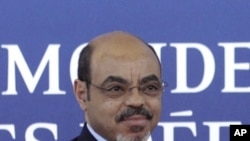
Ethiopia has launched a vigorous defense of an anti-terrorism law that has been used to imprison journalists and opposition politicians. The law's critics call it an effective tool for silencing dissent.
Prime Minister Meles Zenawi on Wednesday lashed out at human rights and press freedom groups that have criticized implementation of Ethiopia's anti-terrorism law.
Answering questions on the floor of parliament, Mr. Meles accused Western monitoring groups of harboring anti-Ethiopian biases that lead them to conclude the law is being misused for political purposes.
He used as an example the case of two Swedish journalists who were arrested in the company of rebels the government classifies as terrorists.
“The government gave a small statement that such people have been put [in] prison," he said. "The next day the campaign was launched, 'Free press, innocent people with no issue at all!' They just give pronouncements before the case has gone to court, before evidence has been heard. The pronouncement was there; the government is the criminal and the people are innocent.”
An Ethiopian court later convicted the two Swedes of supporting terrorism and sentenced them to 11 years in prison. Mr. Meles hinted that the pair might be freed, saying, “We would consider clemency, if the culprits admit their guilt."
Amnesty International, Human Rights Watch and the Committee to Protect Journalists have been vocal critics of the anti-terrorism law. Amnesty International says the statute has been used to jail more than 100 journalists and opposition politicians during the past year. Many have been convicted and handed long prison terms.
Mr. Meles singled out Human Rights Watch for special criticism. He suggested that the group is an agent of forces trying to weaken countries that oppose Western ideology.
“A campaign has been launched against us," he said. "There's a reason behind it. This institution is playing a role of [promoting] ideologies. This organization and its friends' world view are playing a role to speak against some countries, if they look to be on the road to success on an ideology that is different from the current world view. So it's a campaign to [bring]those of us to our knees that deviate from the current world view. There's no connection with human rights.”
The prime minister's comments were the latest jab in a verbal slugfest between Ethiopia and several Western institutions.
The foreign ministry in Addis Ababa last week issued a sharp rebuttal to a New York Times newspaper opinion piece alleging that the government is becoming more repressive, and Mr. Meles increasingly tyrannical. In the piece, columnist Nicholas Kristof defended the Swedish journalists, saying, “their offense was courage” in sneaking into Ethiopia's insurgency-wracked Ogaden region to investigate reports of human rights abuses.
A letter written to the editor of The New York Times by an Ethiopian embassy official in Washington charged Kristof with trying to incite opposition to the government. A foreign ministry statement said Ethiopia respects media freedom and accused Kristof of getting his facts wrong.
The US-based Committee to Protect Journalists, or CPJ, says the Meles government has driven more journalists into exile during the past 10 years than any other country. CPJ Advocacy Coordinator for Africa Mohamed Keita says the few remaining critical voices in the media are under attack.
"The state media is continuing its smear campaign against the last independent current affairs newspaper, Fiteh," said Keita. "So the numbers speak for themselves. Between 2001 and 2011, at least 79 Ethiopian journalists were forced into exile because they were reporting or commenting on the news, and their opinions and criticisms of the government was equated to anti-state activities."
Ethiopian government spokesmen did not answer telephone calls seeking comment. But in an interview with Bloomberg news, Communications Minister Bereket Simon said Ethiopia differentiates between freedom of expression and terrorism. Referring to criticism of the Swedish journalists' conviction, Bereket said, “This is simply a very wrong defense of foreign journalists who have been caught red-handed assisting terrorists.”
A group of United Nations human rights experts joined the fray last week, urging the Ethiopian government to ensure that the anti-terrorism legislation is not abused.
U.N. Special Rapporteur on the situation of human rights defenders Margaret Sekaggya voiced special concern about the case of Internet blogger and political commentator Eskinder Nega. He faces a possible death penalty, if convicted of violating the statute. Eskinder is on trial, accused of plotting with members of an outlawed political party to commit terrorist acts.
Ethiopian PM Defends Anti-Terror Law, Condemns Critics