



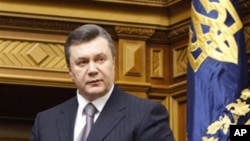
The European Union has postponed a meeting planned this week with Ukrainian President Viktor Yanukovych because of concerns over judicial standards following the jailing of former Ukrainian prime minister Yulia Tymoshenko.
A spokeswoman for EU foreign policy chief Catherine Ashton said Tuesday that the meeting is postponed until conditions become more conducive to making progress in bilateral relations.
Yanukovych had been due to travel Thursday to Brussels, Belgium, meet with European Commission President Jose Manuel Barroso and the president of the EU council, Herman Van Rompuy.
Speaking to reporters, the Ukrainian leader said he was ready to meet but "would not go begging to anyone." Referring to the association agreement with the EU, a key first step to EU membership, he said if either side is not ready, a decision can be made later.
A spokeswoman said the EU wants Ukraine "to make improvement on important issues, such as the rule of law and the independence of the judiciary." The decision followed hints from Yanukovych that Tymoshenko would not be released quickly, even if legislation is passed that would turn her crime into a less serious offense.
The EU decision to call off the meeting comes on the same day that Yanukovych met with Russian President Dmitry Medvedev in the eastern Ukrainian city of Donetsk to discuss economic cooperation. After their talks, Medvedev told a joint news conference that the Tymoshenko trial was an "internal matter" for Ukraine. Analysts say the current tensions with the EU could push Kyiv further into Moscow's orbit.
Tymoshenko was sentenced to seven years in prison on charges of abuse of office in the signing of a natural gas import contract with Russia in 2009, but Tymoshenko's lawyers said they would appeal the verdict.
Tymoshenko has repeatedly denied the charges and described her trial as "a political lynching," aimed at allowing Yanukovych to rid himself of a political rival. The U.S. and the EU have condemned the conviction as politically motivated.
Tymoshenko was expected to be the main opposition candidate in next year's election, but is not eligible to run if the conviction is upheld.
She is one of some 400 officials under investigation for crimes allegedly committed while in office. Critics have noted that the only cases to come to trial involve political opposition figures.
Tymoshenko rose to fame in 2004 as a leader of Ukraine's "Orange Revolution" street protests, which forced the Supreme Court to toss out the results of a disputed election won by Yanukovych. Yanukovych won the last presidential election in 2010.
Some information for this report was provided by AP, AFP and Reuters.