


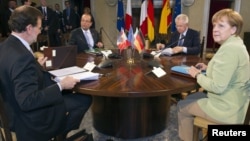
PARIS - Leaders of the four top eurozone economies called for more funds to shore up the region's lagging economy at the end of a tumultuous financial week.
Following talks in Rome, French, German, Italian and Spanish leaders said they had agreed that a new stimulus package worth about $163 billion was critical in rebooting the eurozone economy.
At a joint press conference, French President Francois Hollande said the funds amounted to about 1 percent of the region's gross domestic product. He said that if approved, the package will help spur growth.
The leaders are tying to define a common position ahead of a full-fledged European Union summit next week. The 17-member eurozone is under intense pressure to find a lasting solution to its sovereign debt and banking crisis. In Luxembourg, where EU finance ministers wrapped up two days of talks, International Monetary Fund chief Christine Lagarde jacked up the heat.
"We are clearly seeing additional tension and acute stress applying to both banks and sovereigns [nations] in the euro area," said Lagarde. "And with that in mind, the IMF believes that a determined and forceful move toward a complete European monetary union should be affirmed in order to restore faith in the system. Because as we see it at the moment, the viability of the European monetary system is questioned."
The doubts were underscored this week as Spain's long-term borrowing costs spiked to new highs. Late Thursday, Moody's rating agency also downgraded 15 banks and financial institutions.
But EU members are divided over ways to reboot the eurozone economy. And under French President Hollande, a once-united front between France and Germany has splintered on issues like eurobonds and growth measures.
The finance ministers are also divided on another issue - an EU wide financial transactions tax - with Britain and Sweden strongly against. But a smaller group of nations, led by Germany and France, may ultimately adopt such a levy.
Following talks in Rome, French, German, Italian and Spanish leaders said they had agreed that a new stimulus package worth about $163 billion was critical in rebooting the eurozone economy.
At a joint press conference, French President Francois Hollande said the funds amounted to about 1 percent of the region's gross domestic product. He said that if approved, the package will help spur growth.
The leaders are tying to define a common position ahead of a full-fledged European Union summit next week. The 17-member eurozone is under intense pressure to find a lasting solution to its sovereign debt and banking crisis. In Luxembourg, where EU finance ministers wrapped up two days of talks, International Monetary Fund chief Christine Lagarde jacked up the heat.
"We are clearly seeing additional tension and acute stress applying to both banks and sovereigns [nations] in the euro area," said Lagarde. "And with that in mind, the IMF believes that a determined and forceful move toward a complete European monetary union should be affirmed in order to restore faith in the system. Because as we see it at the moment, the viability of the European monetary system is questioned."
The doubts were underscored this week as Spain's long-term borrowing costs spiked to new highs. Late Thursday, Moody's rating agency also downgraded 15 banks and financial institutions.
But EU members are divided over ways to reboot the eurozone economy. And under French President Hollande, a once-united front between France and Germany has splintered on issues like eurobonds and growth measures.
The finance ministers are also divided on another issue - an EU wide financial transactions tax - with Britain and Sweden strongly against. But a smaller group of nations, led by Germany and France, may ultimately adopt such a levy.