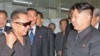



European officials reacted with a mix of hope and watchfulness to the death of North Korean leader Kim Jong Il and apparent power transition to his son.
Reactions in Europe have been slow and cautious to the news of Kim Jong Il's demise.
British Foreign Secretary William Hague sounded a hopeful note, suggesting the North Korean leader's death from an apparent heart attack could be the turning point for the Asian nation.
In a statement, Hague expressed hope the new North Korean leadership would engage with the international community and work for peace and security in the region.
Germany's Foreign Ministry said there is always hope for change, but that Western expectations remain the same - that North Korea give up its nuclear program and improve the plight of its people.
But French Foreign Minister Alain Juppe downplayed prospects for change in the impoverished nation.
Juppe said there is little hope of change, describing North Korea as a completely closed regime, one of the last remnants of the Soviet Union on the planet. He said France is wary about the consequences of the power succession and hopes North Koreans may one day recover their liberty.
North Korea kept news about the death of Kim Jong Il, 69, secret for roughly two days. State institutions released a statement saying his youngest son, Kim Jong Un, is in charge.
Francoise Nicolas, director for Asian Studies at the Paris-based French Institute for International Relations, says the international community has been taken aback by the events.
"Everybody was taken by surprise by his [Kim Jong Il's] death," said Nicolas. "Everybody was expecting his death, but not that quickly."
Very little is known about Kim Jong Il's son, Kim Jong Un, including his exact age.
"It is a big mystery and nobody has any clue what Kim Jong Un, the new leader will do, [will it] be different from what his father was doing, nobody knows," added Nicolas. "He has been in his position for a very short time, he has been appointed a couple of years back. And so nobody has any idea what his plans are, whether he has any plans, whether he has legitimacy within the country.
So it is very, very difficult to know whether there will be changes or not."
Europeans and other Western powers are concerned about North Korea's nuclear capabilities. During Kim Jong Il's 17-year rule, the country exploded two crude nuclear devices, in 2006 and 2009. But Nicolas says European bargaining power to affect change in North Korea is limited.
"As far as the Europeans are concerned, I am afraid they cannot do much," said Nicolas. "They have very little influence on North Korea, they have very little economic interaction with North Korea, so they will not have very much to do or much to show."
Analysts question just how much legitimacy the younger Kim musters in his country. They believe the young man will have to prove himself to the military and forge alliances with other powerful groups.