PARIS — The European Central Bank suggested it might buy the bonds of ailing eurozone economies like Spain and Italy on the open market - but only after the countries first seek bailout funds. The ECB's statements have drawn mixed reaction.
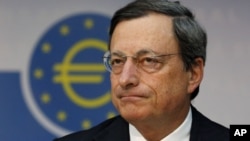
A week after vowing that the European Central Bank would "do what it takes" to save the euro currency, ECB chief Mario Draghi warned markets betting against the17-nation eurozone.
"It's pointless to bet against the euro. It's pointless to go short on the euro. It's pointless because the euro will stay," he said.
Draghi spoke at a press conference following a much-awaited meeting by the ECB's board of governors in Frankfurt. Many hoped the central bank would intervene forcefully to address the financial crisis threatening the future of the currency union.
Some were disappointed. The ECB opted not to change its interest rates, which are already at a record low of 0.75 percent. And Draghi said ailing eurozone members like Italy and Spain must take the first steps by seeking bailouts.
"The adherence of the commitments and the fulfillments of of the EFSF/ESM [bailout fund] of their role are necessary conditions - not sufficient…The [ECB] governing council, within its mandate to maintain price stability over the medium term and in observance of its independence in determining monetary policy, may undertake outright open market operations of a size adequate to reach its objective."
In other words, the ECB is prepared to buy Italian and Spanish bonds on the open market - but only after Rome and Madrid activate bailout funds to do the same thing. That might help curb sky high borrowing costs that both nations face - costs that are threatening their financial stability and that of the eurozone.
The ECB's actions come after a slew of bad financial news in recent days. New data shows a drop in manufacturing and business sentiment in Europe and stubbornly high unemployment.
Some analysts expressed disappointment in the ECB. But London-based Deutsche Bank economist Gilles Moec is more upbeat. Until Spain and Italy request bailout funds, he says, the ECB has gone as far as it can.
"There might be a short-term disappointment because we're still waiting for this decision in Madrid and in Rome to actually trigger this support. But we have a very strong basis now for a new mode of intervention in the European market that can go a long way in addressing the turmoil," he said.
Draghi left out the details of any possible ECB intervention in the markets. He said they would be filled in the coming weeks. And he acknowledged Germany's skepticism about more forceful ECB intervention.
A week after vowing that the European Central Bank would "do what it takes" to save the euro currency, ECB chief Mario Draghi warned markets betting against the17-nation eurozone.
"It's pointless to bet against the euro. It's pointless to go short on the euro. It's pointless because the euro will stay," he said.
Draghi spoke at a press conference following a much-awaited meeting by the ECB's board of governors in Frankfurt. Many hoped the central bank would intervene forcefully to address the financial crisis threatening the future of the currency union.
Some were disappointed. The ECB opted not to change its interest rates, which are already at a record low of 0.75 percent. And Draghi said ailing eurozone members like Italy and Spain must take the first steps by seeking bailouts.
"The adherence of the commitments and the fulfillments of of the EFSF/ESM [bailout fund] of their role are necessary conditions - not sufficient…The [ECB] governing council, within its mandate to maintain price stability over the medium term and in observance of its independence in determining monetary policy, may undertake outright open market operations of a size adequate to reach its objective."
In other words, the ECB is prepared to buy Italian and Spanish bonds on the open market - but only after Rome and Madrid activate bailout funds to do the same thing. That might help curb sky high borrowing costs that both nations face - costs that are threatening their financial stability and that of the eurozone.
The ECB's actions come after a slew of bad financial news in recent days. New data shows a drop in manufacturing and business sentiment in Europe and stubbornly high unemployment.
Some analysts expressed disappointment in the ECB. But London-based Deutsche Bank economist Gilles Moec is more upbeat. Until Spain and Italy request bailout funds, he says, the ECB has gone as far as it can.
"There might be a short-term disappointment because we're still waiting for this decision in Madrid and in Rome to actually trigger this support. But we have a very strong basis now for a new mode of intervention in the European market that can go a long way in addressing the turmoil," he said.
Draghi left out the details of any possible ECB intervention in the markets. He said they would be filled in the coming weeks. And he acknowledged Germany's skepticism about more forceful ECB intervention.