News / Europe

European Leaders Increase Pressure on Mubarak

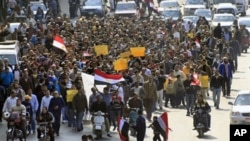
Anti-government protesters march through a street in Cairo, Egypt. Egypt's military threw its weight Friday behind President Hosni Mubarak's plan to stay in office through September elections, February 11, 2011.
TEXT SIZE - +

European governments reacted with a mix of concern and impatience to Egyptian President Hosni Mubarak's refusal to immediately leave office.

The Europeans have been stepping up their calls in recent days for a power change in Egypt, as massive protests continue their calling for President Hosni Mubarak to leave. Those calls were reiterated following the Egyptian leader's televised declaration Thursday that he would not resign right away.

In his own televised remarks after Mr. Mubarak's speech, French President Nicolas Sarkozy said it was inevitable that the Egyptian president would leave office.

Mr. Sarkozy said he hoped Egypt's fledgling democracy took the time to get political training, structures and principles and not move toward religious dictatorship.

Britain's foreign secretary William Hague called for an urgent but orderly transition of power, while Germany's foreign minister said Mr. Mubarak's speech left the international community more worried than before.

In Brussels, European Commission President Jose Manuel Barroso expressed hopes for a peaceful transition in Egypt.

Speaking alongside Spanish Prime Minister Jose Luis Rodriguez Zapatero - and  just before Mr. Mubarak's speech - Mr. Barroso said the events happening in Egypt reminded him of his native Portugal's own transition to democracy from dictatorship.

Following Mr. Mubarak's speech the European Union sharpened its tone, with EU foreign policy chief Catherine Ashton expressing disappointment that the speech did not open the way to faster and deeper reforms.

Ms. Ashton called for the lifting of Egypt's state of emergency as soon as possible. And she said the orderly and irreversible transition to democracy and fair elections was a goal shared by both Europeans and Egyptians.

NEW: Follow our Middle East reports on Twitter
and discuss them on our Facebook page.

You May Like

South Africa to Host World's Biggest Telescope

South Africa competed against Australia to host the telescope, the final decision was to split the SKA between the two countries More

Report: Global Warming Could Reverse Development

World Bank study says warmer climates threaten advances and could exacerbate poverty in world’s poorest regions More

Inmates Fight Fires, Gain Skills for Life After Prison

In California, physically fit inmates with no history of violent crimes can train, work as firefighters while serving their time More

This forum has been closed.
Comments
     
There are no comments in this forum. Be first and add one

Featured Videos

Your JavaScript is turned off or you have an old version of Adobe's Flash Player. Get the latest Flash player.
Video

Video Human Rights Film Festival Highlights Gender, Economic Issues

Twenty new films from around the world are screening in New York this week, as part of the 24th annual Human Rights Watch Film Festival, co-presented by the Film Society of Lincoln Center and IFC Center. The issues explored range from the rights of women, gays and the disabled, to economic justice, to political murder, torture and wrongful imprisonment. VOA’s Carolyn Weaver reports from New York.