



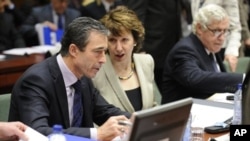
European defense ministers are meeting in Brussels to examine how to remain militarily effective, including sharing resources, at a time of fiscal austerity.
Less than a month ago, U.S. President Barack Obama and European leaders agreed to revamp the NATO defense alliance to meet new and daunting challenges in the 21st century. Obama announced the aims of the new, so-called 'strategic concept' during a NATO summit in Lisbon.
"We have reaffirmed the central premise of NATO - our Article 5 on commitment that an attack on one is an attack on all," said president Obama. "And to ensure this article has meaning, we agreed action in a third area, to modernize our conventional forces and develop the full range of military capabilities that we need to defend our nations."
But doing this takes money - at a time European countries are slashing their defense budgets, sometimes drastically. That's the dilemma European defense ministers are confronting as they meet in Brussels.
Tomas Valasek, director of foreign and defense policy at the London-based Center for European Reform, says Europe's defense cuts pose a big problem for the NATO alliance and Europe's own ability to defend itself.
"This is serious," said Valasek. "The reality is that all of the assumptions in the new strategic concept which NATO has just approved a few weeks ago in Lisbon depend on all these ideas being resourced."
Deeper defense collaboration among European countries may offer one option of saving money by pooling resources. In Brussels, European Union foreign policy chief Catherine Ashton is outlining ways EU countries can share military resources.
France and Britain paved the way last month, striking a deal to collaborate on nuclear weapons research, aircraft carriers and training programs, among other areas.
"There's simply no need for the European members of NATO to have all these duplicating commands, educational systems, exercise ranges," added Valasek. "There's a lot more we can do together and a lot of money to be saved by abolishing duplication in Europe."
Valasek says similar military cooperation is possible among Nordic and Benelux countries. But Valasek, for one, does not expect these regional initiatives to expand to a European-wide project - since military defense is ultimately a very politically sensitive issue.