


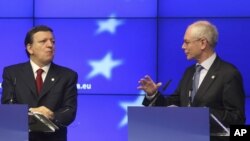
PARIS - European leaders wrapped up a one-day meeting in Brussels early Thursday calling for growth and for Greece to remain in the euro currency union. But they delivered few specifics on the way forward and are sharply divided on some new measures, like eurobonds.
Speaking to reporters after a European Union dinner meeting in Brussels, the EU's president Herman Van Rumpoy said leaders were united on a three-pronged growth strategy.
"First, we need to mobilize EU policies to fully support growth. Second, we need to step up our efforts to finance the economy through investments and third we need to strengthen job creation," he said.
Boosting growth is the new byword in Europe, as some reports predict the eurozone economy will contract again this year as anti-austerity protests mount. Greece remains the key focus of European concern. The country holds a second round of parliamentary elections that some analysts say amount to a referendum on whether it will remain in the euro currency union.
Van Rompuy reaffirmed European support for Greece to stay in the eurozone.
"We want Greece to remain in the euro area while respecting its commitments. We are fully aware of the significant efforts already made by the Greek citizens. The eurozone has shown considerable solidarity - having already disbursed with the IMF nearly 150 billion euros [$189 billion] in support of Greece since 2010," he said.
The dinner talks in Brussels aimed to prepare for a formal EU summit next month. But the European leaders left without agreeing on specific steps forward. France's new President, Francois Hollande is pushing eurobonds - a form of jointly issued debt - among stronger actions to spur growth. Economic powerhouse Germany is against eurobonds.
At an early morning news conference, Hollande acknowledged the disagreements over eurobonds and other new measures, but described the Brussels meeting as a first step to discuss them.
Speaking to reporters after a European Union dinner meeting in Brussels, the EU's president Herman Van Rumpoy said leaders were united on a three-pronged growth strategy.
"First, we need to mobilize EU policies to fully support growth. Second, we need to step up our efforts to finance the economy through investments and third we need to strengthen job creation," he said.
Boosting growth is the new byword in Europe, as some reports predict the eurozone economy will contract again this year as anti-austerity protests mount. Greece remains the key focus of European concern. The country holds a second round of parliamentary elections that some analysts say amount to a referendum on whether it will remain in the euro currency union.
Van Rompuy reaffirmed European support for Greece to stay in the eurozone.
"We want Greece to remain in the euro area while respecting its commitments. We are fully aware of the significant efforts already made by the Greek citizens. The eurozone has shown considerable solidarity - having already disbursed with the IMF nearly 150 billion euros [$189 billion] in support of Greece since 2010," he said.
The dinner talks in Brussels aimed to prepare for a formal EU summit next month. But the European leaders left without agreeing on specific steps forward. France's new President, Francois Hollande is pushing eurobonds - a form of jointly issued debt - among stronger actions to spur growth. Economic powerhouse Germany is against eurobonds.
At an early morning news conference, Hollande acknowledged the disagreements over eurobonds and other new measures, but described the Brussels meeting as a first step to discuss them.