The European Central Bank is keeping its key interest rate unchanged, even as its leader says there is "increased downside risk" for economic growth in the euro currency bloc.
The bank kept its key lending rate at a record low 1 percent Wednesday, despite some calls from European bankers and financial analysts for cutting it to spur the continent's stagnant economy. The 17-nation eurozone is struggling to resolve its governmental debt crisis, as concern mounts over Spain's financially troubled banks and whether Greece becomes the first country to exit the currency union.
Britain says Prime Minister David Cameron and U.S. President Barack Obama agreed in a telephone call late Tuesday that the eurozone nations need an "immediate plan" to resolve the crisis, now in its third year, to restore investors' confidence, and then secure a stronger euro.
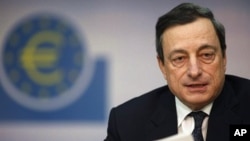
European Central Bank president Mario Draghi said economic growth "remains weak" in the eurozone and there is "heightened uncertainty" that weighs on the confidence of businesses and consumers.
"In the governing council's assessment, the economic outlook for the euro area is subject to increased downside risk, relating in particular to a further increase in tensions in several euro area financial markets, and their potential spillover to the euro area real economy," he said.
But Draghi predicted there would be a gradual improvement in the coming months. The bank left its economic growth projection unchanged, saying that the eurozone economy could advance by up to one-half of one percent this year.
In the meantime, Spain's banking crisis remains unresolved.
Spanish Finance Minister Luis de Guindos said the government would decide within the next two weeks how to finance the $100 billion recapitalization of Spanish banks faced with mounting losses on toxic real estate loans. Spain could seek some form of a rescue package from its European neighbors, who already have sent billions of dollars in bailouts to Greece, Portugal and Ireland during the past two years.
Greek voters are headed to a second round of parliamentary elections June 17, after a splintered vote last month left the country's fractious political parties unable to form a new coalition government.
European leaders have called on the Athens government to keep its earlier pledge to impose new austerity measures in exchange for its second bailout in two years. But there is widespread opposition to the spending cuts within Greece and the election has effectively become a referendum on whether it stays in the eurozone.
The bank kept its key lending rate at a record low 1 percent Wednesday, despite some calls from European bankers and financial analysts for cutting it to spur the continent's stagnant economy. The 17-nation eurozone is struggling to resolve its governmental debt crisis, as concern mounts over Spain's financially troubled banks and whether Greece becomes the first country to exit the currency union.
Britain says Prime Minister David Cameron and U.S. President Barack Obama agreed in a telephone call late Tuesday that the eurozone nations need an "immediate plan" to resolve the crisis, now in its third year, to restore investors' confidence, and then secure a stronger euro.
European Central Bank president Mario Draghi said economic growth "remains weak" in the eurozone and there is "heightened uncertainty" that weighs on the confidence of businesses and consumers.
"In the governing council's assessment, the economic outlook for the euro area is subject to increased downside risk, relating in particular to a further increase in tensions in several euro area financial markets, and their potential spillover to the euro area real economy," he said.
But Draghi predicted there would be a gradual improvement in the coming months. The bank left its economic growth projection unchanged, saying that the eurozone economy could advance by up to one-half of one percent this year.
In the meantime, Spain's banking crisis remains unresolved.
Spanish Finance Minister Luis de Guindos said the government would decide within the next two weeks how to finance the $100 billion recapitalization of Spanish banks faced with mounting losses on toxic real estate loans. Spain could seek some form of a rescue package from its European neighbors, who already have sent billions of dollars in bailouts to Greece, Portugal and Ireland during the past two years.
Greek voters are headed to a second round of parliamentary elections June 17, after a splintered vote last month left the country's fractious political parties unable to form a new coalition government.
European leaders have called on the Athens government to keep its earlier pledge to impose new austerity measures in exchange for its second bailout in two years. But there is widespread opposition to the spending cuts within Greece and the election has effectively become a referendum on whether it stays in the eurozone.
Some information for this report was provided by AP and Reuters.