European leaders are gathered in Brussels for another summit, facing new concerns that their austerity policies are adding to the continent's unemployment problem and weakening the chances for an economic recovery.
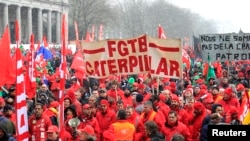
Thousands of workers gathered outside the summit meeting place Thursday to protest the austerity policies that European governments have embarked on to cut their deficits and long-term debts. The European Union leaders were faced with a new report that the number of people working in the 17-nation euro currency bloc in the final months of 2012 fell to its lowest point in nearly seven years.
One Belgian union activist, Claude Rolin, says austerity measures hurt workers and damage economies.
"Austerity does not work. In short, austerity is socially unfair because it hurts those who are victims of the crisis, it is economically stupid because it does not work," he said. "We have seen it in Greece and everywhere in Europe: austerity is counter-productive. It kicks companies out of business. It puts people in misery. What we want is another policy that is intelligent and creates sustainable growth.''
Dutch Prime Minister Mark Rutte, who advocates budget restraints, said the heads of state will "discuss growth and employment and how to fight the present economic deterioration in Europe."
EU President Herman Von Rompuy said the leaders "cannot turn a blind eye to the social emergency in some of our countries." The eurozone unemployment rate reached a record 11.9 percent in January, and nearly one of every four youths is out of work.
The European leaders are facing conflicting demands to continue to rein in deficit spending that forced them to bail out Greece, Ireland, Portugal and the Spanish banking system and at the same time advance a stagnant continental economy. In one sign of the discontent over austerity, an anti-austerity party won 25 percent of the vote in last month's Italian elections, leaving its government in turmoil.
The eurozone leaders could ease the borrowing terms for financially troubled countries, but the eurozone's economic leader, Germany, remains opposed to weakening its austerity stance.
Thousands of workers gathered outside the summit meeting place Thursday to protest the austerity policies that European governments have embarked on to cut their deficits and long-term debts. The European Union leaders were faced with a new report that the number of people working in the 17-nation euro currency bloc in the final months of 2012 fell to its lowest point in nearly seven years.
One Belgian union activist, Claude Rolin, says austerity measures hurt workers and damage economies.
"Austerity does not work. In short, austerity is socially unfair because it hurts those who are victims of the crisis, it is economically stupid because it does not work," he said. "We have seen it in Greece and everywhere in Europe: austerity is counter-productive. It kicks companies out of business. It puts people in misery. What we want is another policy that is intelligent and creates sustainable growth.''
Dutch Prime Minister Mark Rutte, who advocates budget restraints, said the heads of state will "discuss growth and employment and how to fight the present economic deterioration in Europe."
EU President Herman Von Rompuy said the leaders "cannot turn a blind eye to the social emergency in some of our countries." The eurozone unemployment rate reached a record 11.9 percent in January, and nearly one of every four youths is out of work.
The European leaders are facing conflicting demands to continue to rein in deficit spending that forced them to bail out Greece, Ireland, Portugal and the Spanish banking system and at the same time advance a stagnant continental economy. In one sign of the discontent over austerity, an anti-austerity party won 25 percent of the vote in last month's Italian elections, leaving its government in turmoil.
The eurozone leaders could ease the borrowing terms for financially troubled countries, but the eurozone's economic leader, Germany, remains opposed to weakening its austerity stance.