


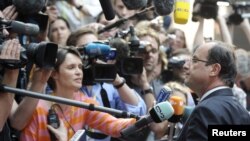
PARIS - Leaders of the 27 nations that comprise the European Union have opened a summit aimed at solving the bloc's debt crisis.
The dinner summit in Brussels will be dominated by increasing calls for growth measures, the creation of jobs and stimulating the troubled eurozone economy, which has been hit with grim news. This week, the Paris-based Organization for Economic Cooperation and Development warned that the eurozone risked severe recession.
The EU's focus has shifted from austerity to pro-growth policies since the election of Socialist Francois Hollande as president of France and the political stalemate in Greece, where voters rejected the political parties that agreed to severe budget cuts in exchange for a financial bailout package. Hollande's influence is at odds with German Chancellor Angela Merkel, who has led the austerity drive since the debt crisis began.
An economist with the U.S.-based Carnegie Endowment for International Peace, Uri Dadush, said the austerity measures will prevail in the end because the markets will not finance current or increased levels of debt.
Pressure for strong and speedy action is mounting amid fears that the eurozone's weakest member, Greece, may soon exit the 17-nation currency union, a move that could spark a larger crisis.
Thomas Klau, head of the Paris office of the European Council on Foreign Relations, said the eurozone has a long way to go before regaining stability.
"I don't think the eurozone has turned the corner," Klau said. "It's turned the corner in terms of the political will. I think the mainstream parties across the eurozone are very strongly committed to keeping the eurozone intact and see it through this crisis. But I don't think they've done enough to make that commitment work in practice."
All ideas on the table
According to European Council President Herman Van Rompuy, no ideas for resolving the issues are unacceptable for Wednesday's summit. He also said long-term solutions should be explored.
The ideas expected to be raised include issuing so-called eurobonds, under which wealthier European nations would guarantee the borrowing costs of financially struggling countries. Merkel is adamantly opposed to eurobonds, a stance shared by Finland, The Netherlands and Austria.
But the idea of eurobonds is gaining traction in Europe. Some top EU officials, including European Commission President Jose Manuel Barroso, support them.
Barroso recently outlined a modest pilot of "project bonds." He described them as a "completely new mechanism and system of getting some financing and investment in projects that are important in Europe." Klau said the "project bonds" are one area where France and Germany can agree.
The European Parliament just agreed to a pilot program that would use nearly $300 million of "project bonds" in 2012 and 2013 to finance about $5.8 billion in investment projects.
Obama weighs in
Last week, U.S. President Barack Obama weighed in on the eurozone crisis. At the Group of Eight summit just outside Washington, he called for EU leaders to inject growth measures and make budget cuts to stimulate the European economy.
"Today, we agreed that we must take steps to boost confidence and to promote growth and demand while getting our fiscal houses in order," Obama said. "We agreed to the importance of a strong and cohesive eurozone and affirmed our interest in Greece's staying in the eurozone while respecting its commitments."
In addition to discussing ways to stimulate Europe's economy, leaders at the Brussels summit may also consider helping large and troubled European banks like those in Spain that are struggling during the crisis.
But no major decisions are expected until another summit in late June, shortly after Greece holds a new round of elections.
Mike Richman reported from Washington.
The dinner summit in Brussels will be dominated by increasing calls for growth measures, the creation of jobs and stimulating the troubled eurozone economy, which has been hit with grim news. This week, the Paris-based Organization for Economic Cooperation and Development warned that the eurozone risked severe recession.
The EU's focus has shifted from austerity to pro-growth policies since the election of Socialist Francois Hollande as president of France and the political stalemate in Greece, where voters rejected the political parties that agreed to severe budget cuts in exchange for a financial bailout package. Hollande's influence is at odds with German Chancellor Angela Merkel, who has led the austerity drive since the debt crisis began.
An economist with the U.S.-based Carnegie Endowment for International Peace, Uri Dadush, said the austerity measures will prevail in the end because the markets will not finance current or increased levels of debt.
Pressure for strong and speedy action is mounting amid fears that the eurozone's weakest member, Greece, may soon exit the 17-nation currency union, a move that could spark a larger crisis.
Thomas Klau, head of the Paris office of the European Council on Foreign Relations, said the eurozone has a long way to go before regaining stability.
"I don't think the eurozone has turned the corner," Klau said. "It's turned the corner in terms of the political will. I think the mainstream parties across the eurozone are very strongly committed to keeping the eurozone intact and see it through this crisis. But I don't think they've done enough to make that commitment work in practice."
All ideas on the table
According to European Council President Herman Van Rompuy, no ideas for resolving the issues are unacceptable for Wednesday's summit. He also said long-term solutions should be explored.
The ideas expected to be raised include issuing so-called eurobonds, under which wealthier European nations would guarantee the borrowing costs of financially struggling countries. Merkel is adamantly opposed to eurobonds, a stance shared by Finland, The Netherlands and Austria.
But the idea of eurobonds is gaining traction in Europe. Some top EU officials, including European Commission President Jose Manuel Barroso, support them.
Barroso recently outlined a modest pilot of "project bonds." He described them as a "completely new mechanism and system of getting some financing and investment in projects that are important in Europe." Klau said the "project bonds" are one area where France and Germany can agree.
The European Parliament just agreed to a pilot program that would use nearly $300 million of "project bonds" in 2012 and 2013 to finance about $5.8 billion in investment projects.
Obama weighs in
Last week, U.S. President Barack Obama weighed in on the eurozone crisis. At the Group of Eight summit just outside Washington, he called for EU leaders to inject growth measures and make budget cuts to stimulate the European economy.
"Today, we agreed that we must take steps to boost confidence and to promote growth and demand while getting our fiscal houses in order," Obama said. "We agreed to the importance of a strong and cohesive eurozone and affirmed our interest in Greece's staying in the eurozone while respecting its commitments."
In addition to discussing ways to stimulate Europe's economy, leaders at the Brussels summit may also consider helping large and troubled European banks like those in Spain that are struggling during the crisis.
But no major decisions are expected until another summit in late June, shortly after Greece holds a new round of elections.
Mike Richman reported from Washington.