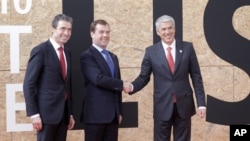
Europeans urged early ratification of a nuclear reduction treaty between the United States and Russia during a NATO summit in Lisbon amid announcements that Moscow would begin working with NATO on missile defense.
After receiving strong support from NATO partners for the START treaty, along with endorsement from top military figures and former administration officials, President Barack Obama told reporters in Lisbon there was no good reason why the U.S. Senate should not now ratify the treaty. "And my hope is we will do so. There's no other reason not to do it other than the fact that Washington has become a very partisan place and this is a classic area where we have to rise above partisanship," he said.
Republican senators have been reluctant to endorse the deal, with a key Republican lawmaker saying they needed more time. But a number of European countries, along with Russia, say it is critical the treaty is ratified in a timely manner. NATO Secretary General Anders Fogh Rasmussen warned that European security was at stake.
Rasmussen also announced that Russia had agreed to cooperate with NATO on missle defense. He called the agreement a turning point in once-hostile NATO-Russian relations that were most recently strained over Georgia. "The practical benefits are clear. By exchanging information that we share, a bigger, wider picture of the skies above Europe we get more warning of a threat and we could, conceivably, even cooperate eventually in shooting down an incoming missile," he said.
In later remarks to the press, Russian President Dmitry Medvedev stopped short of fully endorsing the Europe-U.S. missle defense shield which would protect Europe against missile attack possibly from Iran. Mr. Medvedev said Russia was awaiting more details about the missile shield and would only cooperate as a full partner.
Separately, Mr. Obama did not close the door to a continued U.S. combat presence in Afghanistan after 2014, despite NATO's agreement to hand over full security responsibility to Afghans by the end of that year. "Certainly our footprint will have been significantly reduced. But beyond that, it's hard to anticipate what is going to be necessary to keep the American people safe as of 2014. I'll make that determination when I get there," he said.
Mr. Obama expressed satisfaction about new commitments by NATO partners to send trainers to beef up Afghan security forces, including some from Canada and Italy.
President Obama said the United States will be hosting the next NATO summit in 2012.
Europeans, Russia Urge US Senate to Ratify START Treaty
- By Lisa Bryant