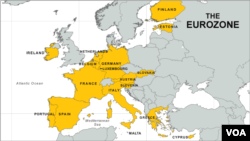
WHITE HOUSE - Much of President Barack Obama’s attention at next week’s Group of 20 economic summit in Mexico's Pacific resort of Los Cabos may be focused on trying to help Europe solve its money problems. Some analysts say Obama’s re-election may depend on it.
“The Eurozone crisis is going to be the first and second leading agenda item when it comes to Los Cabos,” said Stewart Patrick, a senior fellow at the Council on Foreign Relations.
Greece
Sunday’s parliamentary election in Greece could add urgency to efforts to resolve the crisis. Greek voters will decide between candidates who support the austerity measures that come with a European bailout and those who want to scrap the agreement, possibly driving Greece out of the Eurozone.
(Click to Expand)
The Obama administration is hoping that European leaders at the summit can announce the outline of a response to the debt and banking crisis. They also hope the plan will include less austerity and more efforts to encourage growth and stabilize Europe’s financial system.
“And part of that is taking clear action as soon as possible to inject capital into weak banks," the president said. "Just as important, leaders can lay out a framework and a vision for a stronger Eurozone, including deeper collaboration on budgets and banking policy.”
Beyond Europe
Analyst Stewart Patrick says a Eurozone collapse could have effects far beyond Europe.
“There is also a fear that this will help drag down the global economy at a time when some of the major emerging markets, including China but also India, are beginning to falter a little bit in being engines of economic growth,” he said.
Europe is America’s largest trading partner, and failure to put its economy back on track would likely cause trouble for the U.S. economy, which could doom Obama's re-election bid.
US-Russia
While in Los Cabos, the president will have a closely-watched meeting with Russian President Vladimir Putin.
They may discuss Russian opposition to sanctions against Iran and Syria, and Moscow’s suspicion of U.S. plans for a missile defense system in Europe.
But author David Satter, a senior fellow at the Hudson Institute, does not expect progress.
“Those objectives are very unlikely to be achieved at this summit, because the Russian side has no interest in reaching agreements on these issues,” Satter said.
But a majority of the G20 leaders do have an interest in resolving the world's economic problems. They hope to start by convincing the Europeans to resolve their problems first.