Astronomers may have found the most recent black hole to form in our galaxy, and they think it could have been born in a rare explosion caused by a dying star.
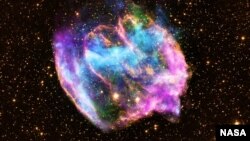
New images from NASA's Chandra X-Ray Observatory, a telescope that observes the cosmos from an orbit 139,000 kilometers above the Earth, suggest that the supernova remnant's oddly-shaped clouds of glowing gas may contain a young black hole.
The remnant, called W49B, is about 1,000 years old. That is equivalent to a blink of an eye in a universe believed to be nearly 14 billion years old.
The Smithsonian Astrophysical Observatory in Massachusetts operates the Chandra telescope. It says, if confirmed, W49B would be the youngest black hole in the Milky Way galaxy.
Supernova explosions occur when massive stars run out of fuel, but NASA notes such blasts are not well understood. The explosions tend to be symmetrical, but supernova remnant W49B is asymmetrical, elongated and elliptical.
Scientists say the distorted shape and the brilliant, colorful X-ray images of the remnant indicate an unusual end for the star.
Astronomers looked for a dense, spinning core, but they saw no evidence of one. They say this means a black hole may have formed.
Laura Lopez, who led the study at the Massachusetts Institute of Technology, said W49B is the first of its kind to be discovered in our galaxy. In a statement on NASA's website, Lopez said, "It appears its parent star ended its life in a way that most others don't."
NASA launched the Chandra X-ray Observatory in 1999. The findings about W49B will be published in an upcoming issue of the Astrophysical Journal.
New images from NASA's Chandra X-Ray Observatory, a telescope that observes the cosmos from an orbit 139,000 kilometers above the Earth, suggest that the supernova remnant's oddly-shaped clouds of glowing gas may contain a young black hole.
The remnant, called W49B, is about 1,000 years old. That is equivalent to a blink of an eye in a universe believed to be nearly 14 billion years old.
The Smithsonian Astrophysical Observatory in Massachusetts operates the Chandra telescope. It says, if confirmed, W49B would be the youngest black hole in the Milky Way galaxy.
Supernova explosions occur when massive stars run out of fuel, but NASA notes such blasts are not well understood. The explosions tend to be symmetrical, but supernova remnant W49B is asymmetrical, elongated and elliptical.
Scientists say the distorted shape and the brilliant, colorful X-ray images of the remnant indicate an unusual end for the star.
Astronomers looked for a dense, spinning core, but they saw no evidence of one. They say this means a black hole may have formed.
Laura Lopez, who led the study at the Massachusetts Institute of Technology, said W49B is the first of its kind to be discovered in our galaxy. In a statement on NASA's website, Lopez said, "It appears its parent star ended its life in a way that most others don't."
NASA launched the Chandra X-ray Observatory in 1999. The findings about W49B will be published in an upcoming issue of the Astrophysical Journal.