



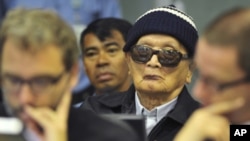
On Monday, the United Nations-backed tribunal investigating Cambodia's murderous Khmer Rouge movement began hearing evidence against three former leaders. The three accused in the long-awaited trial deny charges of genocide, crimes against humanity and war crimes.
Monday's session was dominated by the Khmer Rouge's chief ideologue, Nuon Chea, the man known as Brother Number 2.
In the course of the morning and afternoon sessions, Nuon Chea, who was deputy to the late Khmer Rouge leader Pol Pot, lashed out at Vietnam as he has done consistently over the years.
He blames Cambodia's eastern neighbor, Vietnam, for the crimes with which he and the other defendants are charged. He says people are wrong to accuse the Khmer Rouge.
“Everything was under the control of Vietnam, from the Hanoi headquarters, from the Ho Chi Minh headquarters," said Nuon Chea. "So these crimes; war crimes, crimes against humanity, and genocide were not [by] Cambodian people, it was Vietnam who killed Cambodians.”
It was familiar rhetoric from a man who continues to deny personal responsibility for the policies that cost the lives of as many as 2.2-million people or around one in four of Cambodia's population.
Other than blaming Vietnam and so-called “bad elements” in the revolution that took place in the 1960s and 1970s, Nuon Chea also told the court of his political awakening as a young man living under colonial rule two decades earlier.
“When I was young I lived under the French colony," he added. "I witnessed with my own eyes the mistreatment of the French toward Cambodian people. People were beaten, arrested and imprisoned and I also witnessed the rich mistreated other people. Treated them as slaves.”
He says those injustices motivated his decision.
Nuon Chea says that he only understood Vietnam's designs on Cambodia when he was studying in Hanoi in the early 1950s. He says it was then that he realized that Vietnam wanted to control Cambodia.
“I was so disappointed to hear that, because I was fighting very hard against the French for independence, but what would be independence under the control of another country?” he said.
Nuon Chea was the only defendant to address the court on Monday. The former head of state Khieu Samphan will speak later, once the tribunal has finished hearing from Nuon Chea.
The third defendant, former foreign minister Ieng Sary, has said he will not testify.
Given the complexity of the case, the age of the defendants, who are all in their 80s, and their health, the tribunal has divided it into a series of smaller trials.
That means it can hand down judgments as it proceeds and reduces the risk that one or more of the defendants could die without a ruling being issued, as happened at the trial of the former Serbian president Slobodan Milosevic.
This first mini-trial will examine the alleged crimes against humanity in the forced movement of people.
That refers to two events in 1975, the year Khmer Rouge took control of Cambodia and drove everyone out of the towns and cities. Later that year, they forced hundreds of thousands of people to move across the country into work camps.
But it appears likely that Nuon Chea will continue to blame others for those deaths.
“I do not want the next generation to misunderstand the history," he said. "I do not want them to think that the KR are bad people, are criminals. Nothing is true about that.”
This first mini-trial is expected to take around two years. Further mini-trials, should they happen, will deal with the other charges; Genocide, war crimes and the other crimes against humanity.