



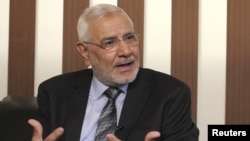
Egyptian presidential hopeful Dr. Abdel Moneim Aboul Fotouh is a practicing physician with extensive experience in international relief work. A former leading figure of the Muslim Brotherhood, he is also a prominent Islamic activist. Known for his relatively liberal positions on social issues, he is supported by young Islamists, liberals and even Egypt's Copts. (You can listen to the full podcast in Arabic here.)
Elshinnawi: If you are elected president, what will priorities will you set for your first 100 days in office?
Aboul Fotouh: Restoring security and stability would be my number one priority because the current laxity in security is a remnant of the Mubarak regime. His police officials are abusing their authority in order to spread instability. Tight security is crucial to restarting our economy and attracting and maintaining the flow of investment.
Elshinnawi: There is one looming challenge for the new president--the sentencing of former President Mubarak, scheduled for June 2nd. If he is acquitted and you are the elected president, what will you do?
Aboul Fotouh: While I respect court rulings, it is a well-known fact that the trials of members of the deposed regime have lacked the cooperation of the executive branch in terms of providing prosecutors and investigators with documents necessary for justice to prevail. So I will not hesitate to order a retrial of Mubarak and his associates. The new trial would take place within a new rule of law to ensure that the judiciary is completely independent from the executive branch.
Elshinnawi: Your platform calls for transforming the Egyptian economy into one of the world's top 20 economies by 2020. How would you be able fulfill that promise, given the ailing state of the Egyptian economy?
Aboul Fotouh: Egypt's economy will never collapse. In the medium range, we will be able to rejuvenate the economy by opening the door to Egyptian, Arab and foreign investment. I have met with many investors, and they have assured me that they are just waiting for the environment to stabilize before resuming their investments in Egypt. They realize that a trusted and elected leadership will pave the way for realizing the great potential of the Egyptian economy.
Elshinnawi: Social justice is a major goal of the Egyptian revolution, but it requires huge resources to achieve. How would you deal with that issue?
Aboul Fotouh: I would work to achieve that goal gradually, starting with two huge projects to provide quality education and healthcare, as well as make improvements to the infrastructure in poorer areas. While Egypt will continue to have a free economy, with private sector comprising 75 percent of all economic activity, the state has to ensure social justice by securing minimum income and providing job opportunities.
Elshinnawi: What role you envision for Egyptian expatriates in rebuilding Egypt?
Aboul Fotouh: We now have about 8 million Egyptians living abroad. We trust their loyalty and love for their homeland. Most of these Egyptians left the country because they were fleeing 30 years of an authoritarian regime and its corruption. Now they can contribute to rebuilding a post-revolutionary Egypt either through their technical skill or investment.
Elshinnawi: You have promised to make the Egyptian army the strongest in the region. Would you maintain the army's economy as it has been running--apart from the general budget?
Aboul Fotouh: Nothing would operate outside the state budget. Anything that currently falls outside the budget will be brought back into it, because my platform calls for budget unity. All national resources will be subjected to scrutiny and auditing. That would not contradict our keen interest in supporting a strong professional army to protect our homeland and secure our development.
Elshinnawi: Some still consider you a candidate for the Muslim Brotherhood and fear if they were to vote for you, Egypt would end up being controlled by an Islamist parliament, government and an Islamist president. What would you say to them?
Aboul Fotouh: There is no problem in having a Muslim Brotherhood candidate, but as I announced from day one, I am running as an independent candidate, representing all Egyptians. I chose to be independent to serve the whole country, as opposed to representing a single party or a single group. Now, we see that the Muslim Brotherhood has fielded a second candidate after their first choice was disqualified. So no one can claim that I am the Muslim Brotherhood candidate.
Elshinnawi: Some Islamists are calling for changing the constitution to implement Islamic law. Do you agree with them?
Aboul Fotouh: Nothing needs to be changed. Article Two of the constitution stipulates that Islamic law is the major source for legislation. That notion is still widely supported by all and would not be touched. Egypt has been a civil--not a theocratic--state for 15 centuries and will be a modern democratic state that respects Islamic law as a reference for legislation under the auspices of the High Constitutional Court.
Elshinnawi: Some presidential candidates have pledged to reconsider the Camp David accords or renegotiate some of its articles. What are your thoughts?
Aboul Fotouh: This treaty needs and deserves reconsideration. The elected parliament should review and reconsider the Camp David agreement, because some of its articles encroach on Egyptian national security and interests.
Elshinnawi: U.S. – Egyptian relations are considered important to both countries. During Mubarak’s era, that relationship entailed strategic cooperation. How do you see the future of Egypt’s relationship with the U.S.?
Aboul Fotouh: We are keen to have good relations with the U.S., but we need to reformulate that relationship in order to secure Egypt’s interests and prevent Egypt from being a satellite state. As for strategic cooperation, it is a term that was coined to, in essence, make Egypt a satellite state in the U.S. policy orbit, at the expense of Egypt’s interests. We will not allow that to be the case with any country. Instead, our relations would be based on common interests and mutual respect.
Elshinnawi: If you are elected president, what will priorities will you set for your first 100 days in office?
Aboul Fotouh: Restoring security and stability would be my number one priority because the current laxity in security is a remnant of the Mubarak regime. His police officials are abusing their authority in order to spread instability. Tight security is crucial to restarting our economy and attracting and maintaining the flow of investment.
Elshinnawi: There is one looming challenge for the new president--the sentencing of former President Mubarak, scheduled for June 2nd. If he is acquitted and you are the elected president, what will you do?
Aboul Fotouh: While I respect court rulings, it is a well-known fact that the trials of members of the deposed regime have lacked the cooperation of the executive branch in terms of providing prosecutors and investigators with documents necessary for justice to prevail. So I will not hesitate to order a retrial of Mubarak and his associates. The new trial would take place within a new rule of law to ensure that the judiciary is completely independent from the executive branch.
Elshinnawi: Your platform calls for transforming the Egyptian economy into one of the world's top 20 economies by 2020. How would you be able fulfill that promise, given the ailing state of the Egyptian economy?
Aboul Fotouh: Egypt's economy will never collapse. In the medium range, we will be able to rejuvenate the economy by opening the door to Egyptian, Arab and foreign investment. I have met with many investors, and they have assured me that they are just waiting for the environment to stabilize before resuming their investments in Egypt. They realize that a trusted and elected leadership will pave the way for realizing the great potential of the Egyptian economy.
Elshinnawi: Social justice is a major goal of the Egyptian revolution, but it requires huge resources to achieve. How would you deal with that issue?
Aboul Fotouh: I would work to achieve that goal gradually, starting with two huge projects to provide quality education and healthcare, as well as make improvements to the infrastructure in poorer areas. While Egypt will continue to have a free economy, with private sector comprising 75 percent of all economic activity, the state has to ensure social justice by securing minimum income and providing job opportunities.
Elshinnawi: What role you envision for Egyptian expatriates in rebuilding Egypt?
Aboul Fotouh: We now have about 8 million Egyptians living abroad. We trust their loyalty and love for their homeland. Most of these Egyptians left the country because they were fleeing 30 years of an authoritarian regime and its corruption. Now they can contribute to rebuilding a post-revolutionary Egypt either through their technical skill or investment.
Elshinnawi: You have promised to make the Egyptian army the strongest in the region. Would you maintain the army's economy as it has been running--apart from the general budget?
Aboul Fotouh: Nothing would operate outside the state budget. Anything that currently falls outside the budget will be brought back into it, because my platform calls for budget unity. All national resources will be subjected to scrutiny and auditing. That would not contradict our keen interest in supporting a strong professional army to protect our homeland and secure our development.
Elshinnawi: Some still consider you a candidate for the Muslim Brotherhood and fear if they were to vote for you, Egypt would end up being controlled by an Islamist parliament, government and an Islamist president. What would you say to them?
Aboul Fotouh: There is no problem in having a Muslim Brotherhood candidate, but as I announced from day one, I am running as an independent candidate, representing all Egyptians. I chose to be independent to serve the whole country, as opposed to representing a single party or a single group. Now, we see that the Muslim Brotherhood has fielded a second candidate after their first choice was disqualified. So no one can claim that I am the Muslim Brotherhood candidate.
Elshinnawi: Some Islamists are calling for changing the constitution to implement Islamic law. Do you agree with them?
Aboul Fotouh: Nothing needs to be changed. Article Two of the constitution stipulates that Islamic law is the major source for legislation. That notion is still widely supported by all and would not be touched. Egypt has been a civil--not a theocratic--state for 15 centuries and will be a modern democratic state that respects Islamic law as a reference for legislation under the auspices of the High Constitutional Court.
Elshinnawi: Some presidential candidates have pledged to reconsider the Camp David accords or renegotiate some of its articles. What are your thoughts?
Aboul Fotouh: This treaty needs and deserves reconsideration. The elected parliament should review and reconsider the Camp David agreement, because some of its articles encroach on Egyptian national security and interests.
Elshinnawi: U.S. – Egyptian relations are considered important to both countries. During Mubarak’s era, that relationship entailed strategic cooperation. How do you see the future of Egypt’s relationship with the U.S.?
Aboul Fotouh: We are keen to have good relations with the U.S., but we need to reformulate that relationship in order to secure Egypt’s interests and prevent Egypt from being a satellite state. As for strategic cooperation, it is a term that was coined to, in essence, make Egypt a satellite state in the U.S. policy orbit, at the expense of Egypt’s interests. We will not allow that to be the case with any country. Instead, our relations would be based on common interests and mutual respect.