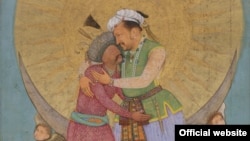
Detail from an allegorical representation of Emperor Jahangir and Shah 'Abbas of Persia' (Courtesy of Arthur M. Sackler Gallery)
The Mughal Emperor Akbar probably would be pleased with the curators at Washington’s Sackler Gallery. The exhibit "Worlds Within Worlds: Imperial Paintings from India and Iran” shows the gallery’s love of painting, particularly the finely-detailed works commissioned by Akbar, his son Jahangir, and his grandson Shah Jahan – the builder of the Taj Mahal.
The Mughals – who reigned from 1526 to 1857 – were direct descendants from Genghis Khan through Chagatai Khan and Timur (also known as Tamarlane). Eventually they controlled most of modern day Pakistan, India, Bangladesh, and Afghanistan. As the Empire expanded, the Mughals imported the finest artists and crafstmen into their court - including from neighboring Persia.
The Mughals were avid readers and collectors – with Emperor Akbar reported to have 24,000 volumes in his library. Akbar’s son Jahangir is thought of as the greatest of the Mughal patrons – with the best books, the best artists, and the best craftsmen available in his court. The Mughal’s artistic tastes embraced many styles, from Persian and Indian painting to European Renaissance styles.
Rare Works on Display
The show offers more than 50 works from the Smithsonian Institution's Sackler and Freer Galleries and chronicles the history of the Mughal Empire from the 14th to the 17th century.
Many of the images on view were taken from large manuscripts or folios and are filled with scenes of adventure, courtly life, and intrigue. They also show the emperors in a positive light, especially Emperor Jahangir, whose names means “World Seizer.”
Debra Diamond is the exhibit’s curator. On a recent tour of the gallery, she said that the exhibit aims to show the diverse and creative atmosphere in the Mughal court, with the emperors embracing many artistic influences.
There are many that hate painting; but such men I dislike.
Akbar, Mughal Emperor
“In paintings made for all three of the emperors (Akbar, Jahangir and Shah Jahan) we can see many, many cosmopolitan moments and interests,” she said.
“One in the subject of the manuscripts themselves, which range from Persian poetry to sacred Hindu texts that were translated from Sanskrit into Persian; two, in the styles that were used – because we have Mughal artists who are both quoting Persian Timurid style and quoting European painting so we see atmospheric perspective, naturalism and shading; and finally in the motifs themselves,” Diamond explained.
Color and Detail
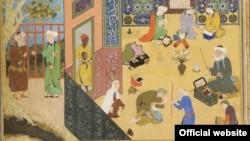
Sa'di and the Youth of Kashgar (Courtesy Arthur M. Sackler Gallery)
The bright colors of the images and the fine details are set off against muted green walls in the gallery. Visitors are provided with magnifying glasses in order to explore the intricate details – including the rays of the sun emanating from Emperor Jahangir’s huge halo in one painting. The paint is opaque water color, with gold and fine pigments setting off the lively images
.
The detail in the paintings is exquisite. Some of the artists used a brush made from the hair of a cat’s tail. Intricate geometric designs surround some of the images. The artwork shows the influence of Persian court artists, through depictions of Akbar’s life, to idealized portraits of Jahangir and Shah Jahan at the beginning of his rule and in his old age.
Religious Diversity Portrayed
The paintings also show the religious tolerance in the courts of Akbar, Jahangir, and Shah Jahan. Though the Mughal’s were Islamic rulers, they welcomed many faiths to their courts, including Jesuit missionaries, and some of the painting backgrounds show European influence in landscapes and perspective. Debra Diamond says religious tolerance was part of the Mughal court.
“We have rulers who are Muslims but who are also extremely tolerant, and often deeply fascinated by other religions,” she said. “And it plays out for each ruler in a slightly different way – partly dependent on politics at the time and partly dependent on their interests.”
Rare Glimpses of Court Life
Three of the images of Emperor Jahangir are so light sensitive that the gallery only allows them out of special storage for six months at a time every five years. Visitors get to see three of these images in “Worlds Within Worlds” – including one where Jahangir sits above other rulers including King James I of England to show his preferred place in the world.
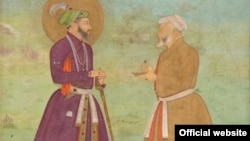
Shah Jahan with Asaf Khan (Courtesy Arthur M. Sackler Gallery)
Shah Jahan’s portraits are more formal – the Emperor is shown in profile as both a young man and an elderly ruler. His hands are clasped and he is surrounded by angels, wildlife and elaborate borders. In one image he is shown with Islamic scholars in the margin of the painting to show his faithfulness. Above the Emperor’s head, angels hold a Timurid diadem to emphasize his descent from Timur, also known as Tamerlane – the Mongol-Turkic ruler who conquered much of West, South, and Central Asia in the 14th and early 15th centuries.
Debra Diamond says “Worlds Within Worlds” gives visitors a rare glimpse of priceless artwork
.
“Most of our exhibitions are 13 weeks,” she said. “But this exhibition because of the light sensitivity of the paintings and because of our desire to bring out all of the great ones at once, is only seven weeks long,” Diamond added.
The exhibit also includes the elaborately decorated cover from the Gulshan – or Rose Garden – Album, which Jahangir worked on for most of his life. Its lacquered surface features finely detailed vignettes of ostriches, dragons, musicians, huntsmen and yogis. The album covers were found just 10 years ago and one of them is displayed is a special case.
“Worlds Within Worlds: Imperial Paintings from India and Iran” is at Washington’s Sackler Gallery. The exhibit continues through September 16.