



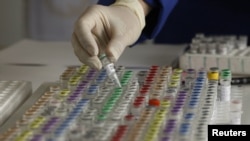
Researchers say devastating birth defects caused by tiny genetic errors in a mother’s DNA could be prevented with a controversial procedure that would produce an embryo from the recombined DNA of a mother, a father and a second female donor. The in-vitro fertilization technique, known as 3-parent IVF, would correct the mother's defective egg with the healthy genetic material from a female donor. The experimental procedure is stirring a big debate in Britain, where medical researchers are hoping to win government approval for human trials.
Three-parent IVF involves producing embryos for implantation in the womb that contain the genetic material of three individuals - two women and a man. It is designed to correct mitochondrial diseases - inherited conditions passed down through the mother's DNA. Mitochondria are the biochemical power plants in every human cell. When they don't function properly, the result is a wide range of mostly neuromuscular problems, some of them devastating. But they also can affect the heart, and cause vision and hearing loss, seizures and serious digestive problems.
To correct the mitochondrial glitch, doctors say they would fertilize the mother’s defective egg with the father’s sperm, and then transfer their genetic material into a hollowed-out egg containing a female donor's healthy mitochondrial DNA. The corrected egg then would be implanted into the mother to carry to term, permanently eliminating the risk of mitochondrial disorders from the family line. That's the theory, anyway.
Elizabeth Chao is medical director of Ambry Genetics in California, which develops prenatal tests for genetic disorders.
Chao said mitochondrial diseases are rare worldwide, with anywhere from one in 6,000 to one in 10,000 children born with the incurable genetic defect. If approved by regulators in Britain, though, where three-parent IVF is now being studied, Chao said the procedure could make a huge difference in the lives of affected families.
“A lot of these diseases are very devastating, and the options to date have been very few for them to prevent disease and to treat disease in their children," said Chao. "And I think this is a real breakthrough that could be remarkable to help a small number of individuals - when used appropriately."
But to David King, director of the British health watchdog group Human Genetics Alert, three-parent IVF is unnecessary and dangerous. He compares it to widely discredited schemes for social engineering.
“That opens the door then to starting to create so-called supposedly superior children with enhanced intelligence and appearance and so on. And we may end up going down much the same road as the Nazis. But rather than it ends up being controlled by the state, it will be controlled by market forces,” said King.
Pointing to experiments in which cloned animals have shortened life spans or are bigger than normal, King also is concerned that the genetically engineered embryos could result in babies with unforeseen physical disabilities that would be passed down to future generations in the modified DNA.
British regulators are expected to rule on the safety of the three-parent IVF procedure next year.
Three-parent IVF involves producing embryos for implantation in the womb that contain the genetic material of three individuals - two women and a man. It is designed to correct mitochondrial diseases - inherited conditions passed down through the mother's DNA. Mitochondria are the biochemical power plants in every human cell. When they don't function properly, the result is a wide range of mostly neuromuscular problems, some of them devastating. But they also can affect the heart, and cause vision and hearing loss, seizures and serious digestive problems.
To correct the mitochondrial glitch, doctors say they would fertilize the mother’s defective egg with the father’s sperm, and then transfer their genetic material into a hollowed-out egg containing a female donor's healthy mitochondrial DNA. The corrected egg then would be implanted into the mother to carry to term, permanently eliminating the risk of mitochondrial disorders from the family line. That's the theory, anyway.
Elizabeth Chao is medical director of Ambry Genetics in California, which develops prenatal tests for genetic disorders.
Chao said mitochondrial diseases are rare worldwide, with anywhere from one in 6,000 to one in 10,000 children born with the incurable genetic defect. If approved by regulators in Britain, though, where three-parent IVF is now being studied, Chao said the procedure could make a huge difference in the lives of affected families.
“A lot of these diseases are very devastating, and the options to date have been very few for them to prevent disease and to treat disease in their children," said Chao. "And I think this is a real breakthrough that could be remarkable to help a small number of individuals - when used appropriately."
But to David King, director of the British health watchdog group Human Genetics Alert, three-parent IVF is unnecessary and dangerous. He compares it to widely discredited schemes for social engineering.
“That opens the door then to starting to create so-called supposedly superior children with enhanced intelligence and appearance and so on. And we may end up going down much the same road as the Nazis. But rather than it ends up being controlled by the state, it will be controlled by market forces,” said King.
Pointing to experiments in which cloned animals have shortened life spans or are bigger than normal, King also is concerned that the genetically engineered embryos could result in babies with unforeseen physical disabilities that would be passed down to future generations in the modified DNA.
British regulators are expected to rule on the safety of the three-parent IVF procedure next year.