


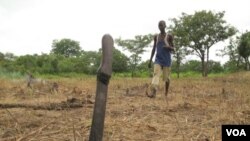
African and U.S. development experts say Africa needs more successful farmers. They say an effective agricultural sector, which is not aid-dependent, is crucial both for ensuring food security as well as political stability. A two-day conference on the topic was recently held in Washington.
With Africa's booming youth population facing daunting employment prospects, University of Ghana-Legon researcher Sam Asuming-Brempong told a crowd of development experts, lawmakers and government officials in Washington, African careers in agriculture need to be promoted.
"When the youth hear of farms they already get scared. We went to a village in Ghana to survey tomato farmers and there was this one man who had made a good return on tomatoes that season. Then we said 'what next?' He said, 'I am going to look for a job in the city.' 'What about the tomato business you are doing? Is it not a job?' we asked. He said, 'no, no, farming is not a job.' We need to do something that will change the mindset of our people," said Asuming-Brempong.
Participants stressed the importance of including farming in school curriculum from the earliest age possible.
Former Mozambique President Joaquim Chissano, who now runs a foundation which bears his name, said it was also important to train future farmers in business practices.
"Training people not only to cultivate the land, to bring more productivity, but how to establish a business. That is why we used the title 'Agriculture is Business'. This is my view since the beginning, how to convert this agriculture into really a business," said Chissano.
The lead organizer of the two-day forum was the U.S.-based Partnership to Cut Hunger and Poverty in Africa. Its aim is to promote sustainable, Africa-led, agriculture-based economic activity in Africa.
Agribusiness specialist Flynn Bucy, with the U.S.-based company Innovare, said foreign governments and aid organizations trying to help with outside money, food and other assistance sometimes get in the way of these goals.
"They can be very disrupting. To give people stuff that will not let them now buy it, to distort prices, there are a lot of people who are trying to help, but part of the result of that is that it makes it very difficult for financial people to come in and make sense of it because it is not being driven by financial logic," said Bucy.
Other challenges which were talked about included soil depletion, water scarcity, massive subsidies for European and U.S. agricultural exporters and foreign governments buying up huge tracts of African land for their own needs.
Participants said the stakes were very high, ranging from ensuring nutrition security to avoiding both repeated famines and urban riots over soaring food prices.
With Africa's booming youth population facing daunting employment prospects, University of Ghana-Legon researcher Sam Asuming-Brempong told a crowd of development experts, lawmakers and government officials in Washington, African careers in agriculture need to be promoted.
"When the youth hear of farms they already get scared. We went to a village in Ghana to survey tomato farmers and there was this one man who had made a good return on tomatoes that season. Then we said 'what next?' He said, 'I am going to look for a job in the city.' 'What about the tomato business you are doing? Is it not a job?' we asked. He said, 'no, no, farming is not a job.' We need to do something that will change the mindset of our people," said Asuming-Brempong.
Participants stressed the importance of including farming in school curriculum from the earliest age possible.
Former Mozambique President Joaquim Chissano, who now runs a foundation which bears his name, said it was also important to train future farmers in business practices.
"Training people not only to cultivate the land, to bring more productivity, but how to establish a business. That is why we used the title 'Agriculture is Business'. This is my view since the beginning, how to convert this agriculture into really a business," said Chissano.
The lead organizer of the two-day forum was the U.S.-based Partnership to Cut Hunger and Poverty in Africa. Its aim is to promote sustainable, Africa-led, agriculture-based economic activity in Africa.
Agribusiness specialist Flynn Bucy, with the U.S.-based company Innovare, said foreign governments and aid organizations trying to help with outside money, food and other assistance sometimes get in the way of these goals.
"They can be very disrupting. To give people stuff that will not let them now buy it, to distort prices, there are a lot of people who are trying to help, but part of the result of that is that it makes it very difficult for financial people to come in and make sense of it because it is not being driven by financial logic," said Bucy.
Other challenges which were talked about included soil depletion, water scarcity, massive subsidies for European and U.S. agricultural exporters and foreign governments buying up huge tracts of African land for their own needs.
Participants said the stakes were very high, ranging from ensuring nutrition security to avoiding both repeated famines and urban riots over soaring food prices.