News / Middle East

    Experts: Nuclear Deal May Spark US-Iran Cooperation Against IS

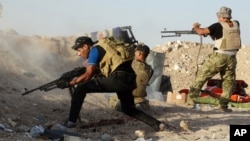
    Iraqi security forces defend their positions against an Islamic State group attack in Husaybah, Iraq, June 15, 2015.
    Iraqi security forces defend their positions against an Islamic State group attack in Husaybah, Iraq, June 15, 2015.

    The nuclear deal struck between Western powers and Iran earlier this week may herald more open cooperation between Washington and Tehran in the fight against Islamic State extremists, analysts say.

    President Barack Obama told reporters Wednesday he did not foresee formalizing any ties with Iran in the fight both countries are waging in Syria and Iraq against the Islamic State. He did appear, however, not to rule out coordination with Iranian military advisers and Tehran-linked Shi'ite militias — if they are working under the command and control of the Iraqi military.

    “The one thing you can count on is that any work that the U.S. government does, or the U.S. military does in Iraq with other partners on the ground is premised on the idea that they are ... under the chain of command of the Iraqi government and Iraqi security forces,” Obama said at a news conference Wednesday at the White House in which he defended the Iran nuclear agreement.

    His remarks now raise the possibility of more open, albeit informal, coordination, argues Jonathan Schanzer, an analyst with the Foundation of the Defense of Democracies, a Washington DC-based think tank.

    “Informal cooperation with Iran in the fight against IS has been Obama's policy in the months leading up to the signing of the deal. It will remain Obama's policy, and it will be bolstered by the nuclear deal, despite not having a formal set of agreements,” he maintains.

    But Schanzer warned, “The president fails to see that the more Iran is involved in the fight, the more IS will be able to recruit Sunni extremists who see the war in Syria and Iraq as a sectarian one. It's a simple equation. An empowered and aggressive Iran will inexorably lead to more mobilized Sunni jihadists.”

    Awkward, secret coordination

    The unusual confluence of interests in both Iraq and Syria, where traditional rivals Tehran and Washington find themselves battling a shared enemy, has prompted a degree of secret — and often awkward — coordination between the American military and Iran’s.

    In order to avoid any mid-air incidents, Iraqi officers have served as intermediaries between the Americans and Iranians, informing each side of upcoming airstrikes, an Iraqi military official confirmed to VOA.

    That coordination appeared to break down in March when Iranian-linked Shi'ite militias fighting to recapture the Iraqi city of Tikrit claimed they had been hit several times by misdirected U.S. airstrikes.

    Tehran said two of its advisers were killed. The Pentagon vehemently denied the accusations, but the claims and counter-claims highlighted the fragility of the makeshift alliance battling to dislodge the militants of the so-called Islamic State from northwest and central Iraq.

    Both sides have consistently played down any cooperation — even if coordination is through a third party.

    In December, U.S. Secretary of State John Kerry told reporters in Brussels: “I think it is self-evident that if Iran is taking on ISIL in some particular place and it’s confined to taking on ISIL and it has an impact... the net effect is positive. But that’s not something that we’re coordinating.”

    However, U.S. officials have noted publicly their concern that Iran’s high-profile military role in Iraq may backfire and stoke the sectarianism dividing Iraq and add to the country’s instability.

    Last year, Admiral John Kirby, the Pentagon press spokesman, said, “Our message to Iran is the same today as it was when it started, and as it is to any neighbor in the region that is involved in the anti-ISIL activities. And that’s that we want nothing to be done that further inflames sectarian tensions in the country.”

    Suspicions on both sides

    The U.S. and Iran have pursued parallel, but at times complementary efforts, in Iraq. Washington has waged mainly an air war against the Islamic State, while training the Iraqi military and backing the Kurdish Peshmerga forces; Tehran has supported and directed Shi'ite militias. With the collapse of the Iraqi army, the Shi'ite militias have proven to be the crucial fighting force.

    But there are signs of cross-over. U.S. soldiers and Shi'ite militia groups have been using the Taqqadum military base in Iraq’s Anbar province, prompting criticism last month from some U.S. lawmakers.

    Republican Senator Tom Cotton of Arkansas, who served in the U.S. Army and fought in Iraq, noted Iran had backed Shi'ite militias and supplied the bombs that killed U.S. troops in Iraq after the U.S. invasion of the country.

    “It's deeply troubling that the president now finds it acceptable to share a military base with this enemy,” Cotton said.

    The Taqqadum military base is where the Pentagon is dispatching 450 additional U.S. military advisers to help train Iraqi military units.

    Suspicions on both sides mark the makeshift alliance. U.S. officials — and Iraqi Sunnis — fear the Shi'ite militias will draw Iraq further into the Iranian orbit and expand Tehran’s clout and influence on its neighbor.

    And Shi'ite militiamen bristle at the American role in Iraq. In March some militia leaders withdrew their forces from Tikrit’s front lines in protest of the American participation.

    Some U.S. officials say they worry about the vulnerability of U.S. military advisers, if Shi'ite militiamen decide to target them.

    Obama also raised the concern Wednesday, saying: “We’re not going to have our troops, even in an advisory or training role, looking over their shoulders because they’re not sure of what might happen to them.”

    The president also noted, though, “Clearly, Iran has influence in Iraq. Iraq has a majority Shia population. They have relationships to Iran.”

    Speaking at a U.S. think tank in Washington Thursday, Gen. John Allen, Obama’s envoy to the global coalition fighting IS, urged caution against viewing the conflict in over-simplified sectarian terms. He noted that Anbar Sunnis opposed to the Islamic extremists have praised the contributions of Shi'ite fighters.

    “They recognize that there is a distinction to be made between many of the Shia hardliners under the influence of Iran and the large number of Shia who answered Grand Ayatollah Sistani’s call to defend Iraq last summer,” he said.

    You May Like

    Why Syria Election Will Hand Assad Victory

    Outcome is foregone conclusion, say opposition politicians and independent election experts who dub next week’s wartime poll a PR stunt

    Victims of Violence Focus Gun Laws in 2016 Campaign

    In New York City, grieving family members of people killed by guns gather at City Hall to urge for more restrictive gun measures

    Closed Borders, Changing Rules Splinter Families Fleeing War

    Greece now faces uncertainty with more than 50,000 refugees, migrants trapped on northern border with Macedonia and crowded into camps, detention centers and makeshift settlements

    This forum has been closed.
    Comment Sorting
    Comments
         
    by: meanbill from: USA
    July 16, 2015 5:43 PM
    FOR SURE. Iran and Iraq doesn't need any [US troops, or US trainers, or US advice], to fight their war against the Sunni Muslim ISIL terrorist army? .. Iraq just wants the warplanes and attack helicopters the US promised them and were bought and paid for in 2011, when the US abandoned their Iraq war against al-Qaeda? .. [Iraq wouldn't need any US airstrike support if they had those warplanes and attack helicopters?] .. and Iraq doesn't need US trained Iraqis abandoning their [American equipment] and throwing down their [American weapons] to the Sunni Muslim ISIL terrorist army? .. [who can trust them?] .. [and?] .. Iran and Iraq both, don't need any US military advice, do they? .. on how to abandon wars? .. who needs it?

    Featured Videos

    Your JavaScript is turned off or you have an old version of Adobe's Flash Player. Get the latest Flash player.
    Spotlight Falls on London as British PM Admits to Profits From Offshore Firmi
    X
    April 08, 2016 10:59 PM
    British Prime Minister David Cameron has admitted that he had profited from a so-called "shell" company set up by his late father. This follows revelations about the scale of offshore wealth exposed by a leak from a Panama-based law firm earlier this week. But it’s Britain’s wider role in the system of offshore finance that is coming under greater scrutiny - as Henry Ridgwell reports from London.
    Video

    Video Spotlight Falls on London as British PM Admits to Profits From Offshore Firm

    British Prime Minister David Cameron has admitted that he had profited from a so-called "shell" company set up by his late father. This follows revelations about the scale of offshore wealth exposed by a leak from a Panama-based law firm earlier this week. But it’s Britain’s wider role in the system of offshore finance that is coming under greater scrutiny - as Henry Ridgwell reports from London.
    Video

    Video Phnom Penh Transforming Overnight with Foreign Investment

    Foreign investors are rushing into Cambodia's frontier property market. Phnom Penh is rising upward almost overnight, but the rate of construction is raising questions about where all the investment is coming from and what effect it will have on the local market. David Boyle reports from the Cambodian capital.
    Video

    Video Panama Tax Haven Revelations Show How Neediest Nations Are Harmed

    The Panama Papers — documents leaked from a Panamanian law firm — reveal a shady side to the global financial system, in which the world’s elite routinely hide money to remain anonymous or to avoid paying taxes. While some argue there’s nothing illegal about the practice, others say the lack of transparency and controls in many tax haven countries comes with a heavy price tag, especially in countries where development money is needed most. VOA's Mil Arcega reports.
    Video

    Video Soap-making Factories Bring Economic Relief to Syrian Town

    War in Syria, now in its fifth year, has adversely affected businesses and local industries. But in one district of the country, the soap-making industry is trying to get back on its feet and providing much-needed employment opportunities to the local population. With Robert Raffaele narrating, VOA’s Amina Misto reports.
    Video

    Video Stranded in Greece, Afghan Interpreters Feel Abandoned By US, Coalition

    Among the tens of thousands of refugees stranded in Greece are many Afghan nationals -- including some who tell VOA they were forced to flee threats from the Taliban because they had worked with US and coalition forces. The United States has a special visa to help Afghans and Iraqis who worked with the US military to gain asylum -- but the refugees say the system takes far too long, and they had to flee for their lives. Henry Ridgwell reports from Athens.
    Video

    Video Experts: IS Looting Antiquities on Industrial Scale

    Experts say the Islamic State is looting and selling cultural antiquities from Iraq and Syria on an industrial scale. The destruction and sale of these treasures is not only condoned but has been institutionalized within the Islamic State itself. And as Jeff Swicord reports, artifacts are beginning to show up on antiquities markets around the world.
    Video

    Video Deportations Bring Unease to Turkey

    Turkey is expecting to receive 200 more migrants deported from Greece on Friday. It is part of the deal reached in March between the European Union and Ankara to alleviate Europe’s migrant crisis. But there is also nervousness among some Turks who question whether their country can and should absorb the refugees who do not return to their nations of origin. VOA Europe Correspondent Luis Ramirez reports.
    Video

    Video Scientists Creating New Devices to Battle Diabetes

    Diabetes is fast becoming a major global problem, affecting 422 million people. But nanotechnology may someday make monitoring blood glucose levels and administering medicine much simpler than it is today. VOA’s George Putic reports.
    Video

    Video Spanish ‘Smart’ City Project Saves Time, Money

    As life in cities worldwide becomes more hectic and more expensive, urban designers are resorting to modern technology to help citizens avoid traffic snarls, and shorten the time needed for shopping and other errands. Technology also is used to cut costly waste. Zlatica Hoke has this report about a city in Spain that is turning into a model "smart city" others seek to emulate.
    Video

    Video New Abidjan Car Services Inspired by Uber

    Uber, the U.S.-based online transportation network company, operates a mobile app that allows consumers with smartphones to book cab service from Uber drivers who use their own cars. As the company makes inroads in Africa, entrepreneurs in the West African nation of Ivory Coast are trying to stay one step ahead. Emilie Iob reports from the Ivorian commercial capital, Abidjan, where at least four Uber-like car services have launched since last year.
    Video

    Video Young Yazidi Refugee Paints About Islamic State 'Nightmare'

    Mariam Marwan was 16 when Islamic State militants stormed her village in Iraq, forcing her family to flee to the Sinjar Mountains. Now 18, Miriam says she constantly relives the nightmare but hopes her images will serve as a record of what happened to the Yazidi people.
    Video

    Video Top Honor Given to US Military Dog Injured in Combat

    A U.S. Military Service dog that saved the lives of thousands of troops by sniffing out explosives has been awarded the highest honor of bravery by a British animal charity. Henry Ridgwell met Lucca the German Shepherd at an award ceremony in London and reports for VOA.

    Special Report

    Adrift The Invisible African Diaspora