


Concerns over the extent of U.S. military aid in war-torn Somalia as well as challenges for the U.S. military command structure in Africa are leading American experts to scrutinize the U.S. security role on the continent.
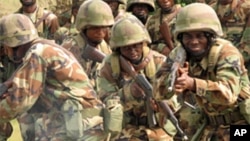
At a briefing last week, Assistant Secretary of State Johnnie Carson denied recent media reports that the United States is leading military efforts to help Somalia's government, known as the transitional federal government, or TFG, defeat insurgents.
"[The] United States does not plan, does not direct, and does not coordinate the military operations of the TFG," said Johnnie Carson. "And we have not and will not be providing direct support for any potential military offensives. Further, we are not providing or paying for military advisors for the TFG. There is no desire to Americanize the conflict in Somalia."
But important military ties exist. Last year, a State Department official said the U.S. government had provided Somalia's transitional government with millions of dollars to buy weapons and ammunition. U.S. contractors have also been involved in training Somalia's security forces.
Eighteen American soldiers died in Somalia in 1993 in the last major ground operation involving U.S. troops in Africa. But important covert operations in conflict situations reportedly have continued, including in Somalia.
In terms of U.S. security involvement for the continent, the United States established the U.S. Africa Command, or AFRICOM, in 2007. Its commander, Army General William Ward, recently testified on Capitol Hill that the command is still based in Germany because, he said, public opinion in Africa makes it counter-productive to base its command there.
Daniel Volman, director of the U.S.-based Africa Security Research Project, says this does not mean that AFRICOM is inactive.
"Even though, they are based in Stuttgart, General Ward and his people spend about half of their time on the African continent," said Daniel Volman. "They have also begun building up the level of U.S. military personnel at all the U.S. embassies, so they can have mini AFRICOM headquarters in every single country."
Volman says a growing U.S. need for natural resources is one of the main reasons the Defense Department developed AFRICOM, in light of instability in places such as oil-rich Nigeria.
"For the Pentagon, the nightmare scenario is that Nigeria will descend into chaos," he said. "Infighting in Nigeria will reach a point where oil production will actually be directly threatened, and then what do you do? Do you send American troops into Nigeria? And the people at the Pentagon are already doing war-gaming and contingency planning for that - not because they particularly want to do that, but because they recognize how important Nigeria is to the United States."
Mark Davidheiser, director of the newly-created U.S.-based Africa Peace and Conflict Network, says he believes that concerns over terrorism trump all else when it comes to AFRICOM.
"I mean the real concern is terrorism," said Mark Davidheiser. "That is what is motivating this program, I believe. There has been a lot of worry about the lack of robust governance in Africa and the rather loose or patchy rule of law that exists in many places. So the fear is that Africa can become a haven for extremists."
The United States has also had long standing military ties with African countries with fewer resources and no visible terrorist threat, such as Guinea, where recent years have been marked by power struggles within the military. When former coup leader turned long-time president Lansana Conte died in late-2008, a soldier took over in a coup, before barely surviving an assassination attempt by another soldier.
Steven McDonald, an expert with the Africa program at the Woodrow Wilson International Center for Scholars here in Washington, says the example of Guinea points to some of the challenges the United States faces in helping militaries in Africa.
"Whether they had seen it as a 'poster child' [leading example] in the sense of military relations or not, I kind of doubt that," said Steven McDonald. "I think there was a great deal of hope placed on it that there would be a different kind of transition there. And I am sure there have been attempts behind the scenes to try to dissuade and recoup what has happened. But it is probably just another example of why in smaller countries like that where it does not stand high on our priorities of interests in terms of our own national interest that we have very limited leverage, and we learn it when things like this happen."
Mark Davidheiser of the Africa Peace and Conflict Network regrets the emphasis that has been placed on U.S.-Africa military relations.
"It saddens me that that has been such a pillar of U.S. policy - giving military aid, training, sending advisors, training local military members by U.S. trainers, who often, history has shown, have turned around and then been involved in all sorts of brutalities and human rights violations against the populations there," he said.
In the case of Guinea, human rights groups say the country's military, which received support and training from the United States, was responsible for the killing of 150 demonstrators at a stadium in the capital Conakry last year. Senior military officials have blamed renegade soldiers for the violence.
Guinea's military rulers now say they will not run in elections scheduled for June.
U.S. military officials say they are actively training security forces across the African continent to fight not only terrorism, but also drug and human trafficking as well as piracy.
Experts Scrutinize US Role in African Security