


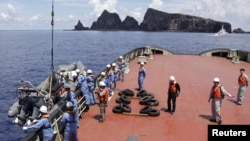
The United States says it is staying out of a Japanese-Chinese dispute about uninhabited islands in the East China Sea, but its position on the issue has angered Beijing and caused some anxiety in Tokyo.
Some regional experts say the Japanese and Chinese concerns are linked to decades-old U.S.-Japan treaty obligations.
The Obama administration says it takes "no position on the ultimate sovereignty" of the Japanese-controlled archipelago, known as Senkaku in Japan and Diaoyu in China. The surrounding waters contain rich fishing grounds and potential oil and mineral reserves.
It repeatedly has urged the two countries to avoid incidents that could escalate the dispute, and to begin negotiations to resolve it.
Japan annexed the tiny islands in 1895 and held them until the end of the Second World War, when the United States took control. Washington returned the islands to Japanese control in 1972, drawing protests from Beijing, which declared them to be Chinese territory the year before.
The dispute flared up again last month, when Chinese and Japanese nationalists landed on the islands to assert their countries' claims. U.S. officials responded by urging Tokyo and Beijing to resolve the dispute peacefully.
1960 defense treaty
U.S. Naval War College professor Toshi Yoshihara said the U.S. position is complicated by a 1960 treaty pledging a U.S. military response to an attack on Japanese-administered territories.
U.S. officials have said they see the disputed islands as part of the territories covered by that defense treaty. But they have refused to elaborate on what circumstances would trigger U.S. military intervention.
Yoshihara said Washington does not want to say anything that could encourage Japan to confront China. But he said the U.S. approach also makes some Japanese policy makers uncomfortable.
"'Some Japanese seem preconditioned to doubt American reassurances [about the islands] and would prefer more clarity," he said.
U.S. attempts to reassure Japan about the treaty have upset China. This week, as Secretary of State Hillary Clinton traveled in Asia, Chinese state media accused Washington of having a "dangerous" and "contradictory" policy on the islands because it recognizes Japan's administration of them and calls them by the Japanese name.
Watch related video
1972 military agreement
Another complication in the U.S. position arises from a 1972 Status of Forces Agreement under which Japan allowed the U.S. military to use two of the disputed islands as bombing ranges for an "indefinite" period.
One of those islands, known in Japan as Kuba, is owned by a Japanese family. Tokyo calls the other one Taisho and says it is state property. Japan says the U.S. military has not used either of them for training since 1978.
Professor Yusuke Anami of Japan's Tohoku University said the Japanese government, though, has been renting Kuba from its owners since 1972 " just so that U.S. Forces in Japan might use it [again] some day."
He said the government faced criticism in 2010 for spending taxpayer money on an unused firing range.
Japan's foreign ministry told VOA that Washington has not expressed any intention to return the two ranges to Japan. It said Tokyo "understands that these facilities and areas are continuously needed" to fulfill the defense treaty.
Frank Gaffney, the head of the Center for Security Policy in Washington, said that maintaining access to the islands is important to the United States, because giving it up could "be perceived as a retreat or sign of weakness by our prospective foes or our friends."
Gaffney also said the islands are valuable because U.S. forces have fewer and fewer areas in which to conduct live-fire exercises. He said U.S. troops also benefit from training in environments similar to those in which they may have to operate.
In response to a VOA question about the firing ranges, a senior U.S. State Department official said "our desire is... to not speculate about defense-related issues with the Senkakus."
Yoshihara at the Naval War College said the United States stopped using the firing ranges in 1978 to avoid destabilizing relations between Japan and China, which were negotiating a peace treaty at the time. He said any military benefits from resuming the exercises are outweighed by the strategic downsides.
Some regional experts say the Japanese and Chinese concerns are linked to decades-old U.S.-Japan treaty obligations.
The Obama administration says it takes "no position on the ultimate sovereignty" of the Japanese-controlled archipelago, known as Senkaku in Japan and Diaoyu in China. The surrounding waters contain rich fishing grounds and potential oil and mineral reserves.
It repeatedly has urged the two countries to avoid incidents that could escalate the dispute, and to begin negotiations to resolve it.
Japan annexed the tiny islands in 1895 and held them until the end of the Second World War, when the United States took control. Washington returned the islands to Japanese control in 1972, drawing protests from Beijing, which declared them to be Chinese territory the year before.
The dispute flared up again last month, when Chinese and Japanese nationalists landed on the islands to assert their countries' claims. U.S. officials responded by urging Tokyo and Beijing to resolve the dispute peacefully.
1960 defense treaty
U.S. Naval War College professor Toshi Yoshihara said the U.S. position is complicated by a 1960 treaty pledging a U.S. military response to an attack on Japanese-administered territories.
U.S. officials have said they see the disputed islands as part of the territories covered by that defense treaty. But they have refused to elaborate on what circumstances would trigger U.S. military intervention.
Yoshihara said Washington does not want to say anything that could encourage Japan to confront China. But he said the U.S. approach also makes some Japanese policy makers uncomfortable.
"'Some Japanese seem preconditioned to doubt American reassurances [about the islands] and would prefer more clarity," he said.
U.S. attempts to reassure Japan about the treaty have upset China. This week, as Secretary of State Hillary Clinton traveled in Asia, Chinese state media accused Washington of having a "dangerous" and "contradictory" policy on the islands because it recognizes Japan's administration of them and calls them by the Japanese name.
Watch related video
1972 military agreement
Timeline of Japan-China Dispute Over East China Sea Islands
1895
Japan unilaterally annexes five islands and three barren rock groups in the East China Sea, calls them "Senkaku." China's Qing Dynasty later cedes Taiwan and adjacent islands to Japan under the Treaty of Shimonoseki, ending the First Sino-Japanese War. Senkaku Islands are not included in the treaty.
1896
Japan's government leases four of the islands, known in Japanese as Uotsuri, Minami, Kita and Kuba, to Tatsushiro Koga.
1945
Japan surrenders, ending World War II, and returns Taiwan and adjacent islands to China in accordance with the Cairo Proclamation and Potsdam Declaration. The U.S. military takes control of the Senkaku Islands.
1969
U.N. report says studies suggest the presence of large oil reserves in the waters of the Senkaku chain.
1971
Taiwan, China, officially claim sovereignty over the islands, calling them "Diaoyu."
1972
Japan regains control of Okinawa and the Senkaku/Diaoyu islands from the United States. Tokyo agrees to let the U.S. military use Kuba and Taisho as firing ranges for an "indefinite" period. Japan's defense ministry begins renting Kuba from its owners to ensure U.S. access to the island. Zenji Koga begins the process of selling Kuba, Uotsuri, Minami and Kita to the Kurihara family. Sale completed in 1988.
2010
September: Japanese coast guard ships collide with a Chinese trawler as they try to chase it from the waters around the islands. Japanese authorities detain the Chinese captain for two weeks, upsetting China, which responds by suspending political and cultural exchanges and stopping rare earth exports to Japan.
2012
July: Japanese Prime Minister Yoshihiko Noda says the central government is in talks to buy the islands from the Kurihara family.
August 15: 14 pro-China activists sail to the islands to assert Chinese sovereignty claims. Five swim ashore before the Japanese coast guard detains all the activists and deports them.
August 19: Japanese nationalists land on Uotsuri to assert Japan's sovereignty claim, ignoring Tokyo's warning that the landing is unauthorized.
One of those islands, known in Japan as Kuba, is owned by a Japanese family. Tokyo calls the other one Taisho and says it is state property. Japan says the U.S. military has not used either of them for training since 1978.
Professor Yusuke Anami of Japan's Tohoku University said the Japanese government, though, has been renting Kuba from its owners since 1972 " just so that U.S. Forces in Japan might use it [again] some day."
He said the government faced criticism in 2010 for spending taxpayer money on an unused firing range.
Japan's foreign ministry told VOA that Washington has not expressed any intention to return the two ranges to Japan. It said Tokyo "understands that these facilities and areas are continuously needed" to fulfill the defense treaty.
Frank Gaffney, the head of the Center for Security Policy in Washington, said that maintaining access to the islands is important to the United States, because giving it up could "be perceived as a retreat or sign of weakness by our prospective foes or our friends."
Gaffney also said the islands are valuable because U.S. forces have fewer and fewer areas in which to conduct live-fire exercises. He said U.S. troops also benefit from training in environments similar to those in which they may have to operate.
In response to a VOA question about the firing ranges, a senior U.S. State Department official said "our desire is... to not speculate about defense-related issues with the Senkakus."
Yoshihara at the Naval War College said the United States stopped using the firing ranges in 1978 to avoid destabilizing relations between Japan and China, which were negotiating a peace treaty at the time. He said any military benefits from resuming the exercises are outweighed by the strategic downsides.