



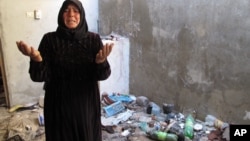
First there is the ongoing civil war. Now freezing winter weather is further threatening the health of hundreds of thousands of Syrians driven from their homes by the fighting and forced to take shelter in the nation’s mosques, empty schools and abandoned construction sites.
Even without the worst winter in 20 years, the health of women, children and the aged has already been compromised by failed health and sanitation systems brought on by the two years of fighting. For a country that once graduated hundreds of physicians and produced more than 90 percent of its own pharmaceuticals, the war has destroyed much of the nation’s medical infrastructure. Cancer patients and children with diabetes no longer receive life-saving treatment.
There have been no major outbreaks of disease yet, health experts agree -- only sporadic cases of hepatitis B. But as the war continues, chances of survival for the nation’s displaced are likely to worsen because of rapidly dwindling medical supplies and a diminishing corps of doctors and nurses.
Public health reporting uneven
Public health reporting in Syria is spotty – and often contradictory – says Dr. Elizabeth Hoff, who monitors the country for the World Health Organization (WHO). The difficulty, she says, is access in the ongoing fighting.
Despite that, Hoff and two other doctors visiting separate regions of Syria report a kaleidoscope of health problems that vary from city to city. One sees serious threats in the water of the Euphrates. Another notes the proliferation of rats in the streets of Aleppo’s Kalaffa district. A third worries about the nation’s cancer patients and the children with diabetes whose life-saving treatments have been ended.
All three look at a brutal winter as a defining moment for the health of a nation of 22.5 million facing the prospect of a lengthening civil war.
Hoff describes a grim picture of life for the hundreds of thousands of displaced Syrians.
“What I have seen -- and I traveled around the country in cities like in Homs, and in the Rif Damascus (suburban) area where there are a large number of internally displaced -- is that they have actually taken refuge in buildings that are missing windows and the doors are open,” Hoff said.
“And at this time of year - today we have snow on the ground in Damascus and in many of the areas the temperature has fallen to below zero - they don’t have the right equipment to stay warm,” she said. “There is no heating in their homes and the price of fuel has gone up tremendously … if they can find it at all.”
Danger lurks in Euphrates River waters
Dr. Mohammad Trad spent several weeks in November working in the region near Deir Azzour, once a regional capital with about 600,000 residents and now almost abandoned. Trad said he saw large groups of homeless people camping along the shores of the Euphrates River.
“Now, that river is known to be contaminated with schistosomiasis, which is endemic in those waters,” Trad said, adding that the homeless were reporting increasing cases of diarrhea among children using Euphrates water.
Another chronic problem in the area is a high rate of Thalasemmia, a blood condition that can cause anemia and can lead pneumonia, bone deformities and cardiovascular illness.
A pediatrician warns of plague potential plague in Aleppo
Dr. Yahiya Rahim is a pediatrician who lives in Florida, but volunteered to help in his hometown of Aleppo. He couldn’t visit the Saif al-Dawla neighborhood where he grew up because of the threat of sniper fire, but he worked in one of several underground hospitals in another neighborhood, Kalaffa, a frequent target of rockets attacks.
“I was there because I was the only pediatrician in that area, which is more than a million people.”
While in Aleppo, Rahim says he treated about 60 patients a day: one-third had hepatitis, another third suffered from chest infections.
“I was able to see rats freely during the daytime, which is unusual because they don’t usually come during daytime. They come more at night.”
Rahim said his brother was with him at the time and that they helped out at six makeshift medical centers treating the wounded.
“My brother was working in a hospital where 70 victims of a bakery bombing were delivered,” Rahim said, explaining that treatment was impossible because the diesel generator had run out of fuel and the center had no electrical power for light or heat. He said 10 of the wounded Syrians died of hypothermia.
Rahim said his brother, also a surgeon, performed three Caesarean sections by candlelight. The mothers survived, but the babies – all near full-term- died of hypothermia.
Later, he said outside donations made it possible to buy 26,000 liters of diesel fuel and buy two new generators for the treatment centers.
Now, Rahim says, he is trying to organize a campaign to prevent a possible outbreak of bubonic plague in Syria, which he said could occur in the spring if steps are not taken to remove trash and deal with rat and mosquito infestations in the coming months.
Even without the worst winter in 20 years, the health of women, children and the aged has already been compromised by failed health and sanitation systems brought on by the two years of fighting. For a country that once graduated hundreds of physicians and produced more than 90 percent of its own pharmaceuticals, the war has destroyed much of the nation’s medical infrastructure. Cancer patients and children with diabetes no longer receive life-saving treatment.
There have been no major outbreaks of disease yet, health experts agree -- only sporadic cases of hepatitis B. But as the war continues, chances of survival for the nation’s displaced are likely to worsen because of rapidly dwindling medical supplies and a diminishing corps of doctors and nurses.
Public health reporting uneven
Public health reporting in Syria is spotty – and often contradictory – says Dr. Elizabeth Hoff, who monitors the country for the World Health Organization (WHO). The difficulty, she says, is access in the ongoing fighting.
What I have seen ... in Homs, and in the Rif Damascus (suburban) area ... is that they have actually taken refuge in buildings that are missing windows and the doors are openDr. Elizabeth Hoff, the World Health Organization
All three look at a brutal winter as a defining moment for the health of a nation of 22.5 million facing the prospect of a lengthening civil war.
Hoff describes a grim picture of life for the hundreds of thousands of displaced Syrians.
“What I have seen -- and I traveled around the country in cities like in Homs, and in the Rif Damascus (suburban) area where there are a large number of internally displaced -- is that they have actually taken refuge in buildings that are missing windows and the doors are open,” Hoff said.
“And at this time of year - today we have snow on the ground in Damascus and in many of the areas the temperature has fallen to below zero - they don’t have the right equipment to stay warm,” she said. “There is no heating in their homes and the price of fuel has gone up tremendously … if they can find it at all.”
Danger lurks in Euphrates River waters
Dr. Mohammad Trad spent several weeks in November working in the region near Deir Azzour, once a regional capital with about 600,000 residents and now almost abandoned. Trad said he saw large groups of homeless people camping along the shores of the Euphrates River.
“Now, that river is known to be contaminated with schistosomiasis, which is endemic in those waters,” Trad said, adding that the homeless were reporting increasing cases of diarrhea among children using Euphrates water.
Another chronic problem in the area is a high rate of Thalasemmia, a blood condition that can cause anemia and can lead pneumonia, bone deformities and cardiovascular illness.
A pediatrician warns of plague potential plague in Aleppo
Dr. Yahiya Rahim is a pediatrician who lives in Florida, but volunteered to help in his hometown of Aleppo. He couldn’t visit the Saif al-Dawla neighborhood where he grew up because of the threat of sniper fire, but he worked in one of several underground hospitals in another neighborhood, Kalaffa, a frequent target of rockets attacks.
I was able to see rats freely during the daytime, which is unusual because they don’t usually come during daytime. They come more at nightDr. Yahiya Rahim
While in Aleppo, Rahim says he treated about 60 patients a day: one-third had hepatitis, another third suffered from chest infections.
“I was able to see rats freely during the daytime, which is unusual because they don’t usually come during daytime. They come more at night.”
Rahim said his brother was with him at the time and that they helped out at six makeshift medical centers treating the wounded.
“My brother was working in a hospital where 70 victims of a bakery bombing were delivered,” Rahim said, explaining that treatment was impossible because the diesel generator had run out of fuel and the center had no electrical power for light or heat. He said 10 of the wounded Syrians died of hypothermia.
Rahim said his brother, also a surgeon, performed three Caesarean sections by candlelight. The mothers survived, but the babies – all near full-term- died of hypothermia.
Later, he said outside donations made it possible to buy 26,000 liters of diesel fuel and buy two new generators for the treatment centers.
Now, Rahim says, he is trying to organize a campaign to prevent a possible outbreak of bubonic plague in Syria, which he said could occur in the spring if steps are not taken to remove trash and deal with rat and mosquito infestations in the coming months.