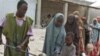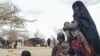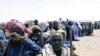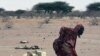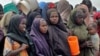



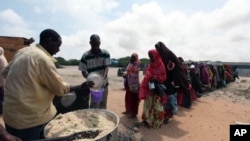
The United Nations says more than half of Somalia's population, four million people, is now in crisis as famine spreads, and 750,000 are at risk of death.
The U.N. Office for the Coordination of Humanitarian Affairs in Somalia reported Monday that famine has extended to Bay, a major food-producing region, and is expected to continue spreading unless aid is increased. The agency says tens of thousands of people have died and hundreds are dying each day, at least half of them children.
The agency’s Somalia coordinator Mark Bowden says much more assistance is needed. “The next four months will be critical in which we have to stabilize the situation,” he said. “The message has been coming across consistently: this is not a short-term crisis.”
The U.N. has appealed for $1.1-billion to respond to the crisis and has raised about 60 percent of that amount, and Bowden says U.N. workers have been able to scale up activities in recent weeks as donors responded to earlier declarations of famine.
The U.N. Food and Agriculture Organization stepped in with cash and seed programs to help keep farmers on their land, but program director Luca Alinovi says it is difficult to secure funding for longer-term programs.
“Mainly we receive money in response to the humanitarian crisis,” said Alinovi. “It is very difficult to get money for a longer-term initiative because most of the donors … want to have a functioning government.”
Logistical challenges
Somalia presents numerous logistical challenges to aid agencies, not the least of which is that the country has not had a functioning central government for the past 20 years.
The al-Qaida linked militant group al-Shabab continues to hold influence in parts of the country, threatening the security of aid workers. The U.N. says it is in discussions with the militant group to get access to some of those areas.
Global response
The African Union said last month at a donors conference that it has raised more than $350 million in cash for drought and famine relief. The AU has been criticized for its slow response to the crisis, which has forced hundreds of thousands of Somalis to flee their homes in search of food and water. Before the conference, the 54-member bloc had pledged only $500,000 in aid.
The United States has pledged more than $500 million in food and refugee assistance. The European Union and its member countries have pledged more than $750 million, while the Organization of the Islamic Conference has pledged $350 million.
With the current humanitarian response level, the U.N. estimates most of southern Somalia will be in famine by the end of the year.