



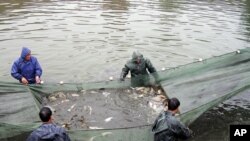
Farmed fish, if raised sustainably, can help feed the world, according to a report by the WorldFish Center, a private group that advocates sustainable fishing.
As overfishing continues to deplete ocean fish populations, farmed fish have stepped in to fill the gap. The report, presented at a conference in Thailand, finds the industry has grown at such a rapid pace that it now supplies nearly half the fish eaten on the planet.
It compares farming practices and fish species across 18 countries. WorldFish director general and report author Stephen Hall says it answers some basic questions “What works best? What’s most efficient? Which things do we need to pay most attention to when we try and think about improving the environmental performance of a very important food production sector?”
Ninety-one percent of farmed fish come from Asia, with China alone accounting for more than 61 percent of that production. Hall says from country to country, and across a range of production systems and fish species, the environmental impact of aquaculture varies widely.
“And that tells us that that there are huge opportunities for the best to learn from the worst and reduce the environmental impact across the globe.”
That impact can be considerable. Waste from poorly managed aquaculture ponds can pollute ground and coastal waters, and certain carnivorous species like salmon must be fed products made from other fish, like oil and meal - meaning continued pressure on wild fish populations.
While Asia dominates aquaculture production, fish farms are common across the globe as in this operation in Egypt. (Jamie Oliver)
The report finds that shrimp and prawn production methods in China had a greater impact on the environment than the methods used in Thailand or Vietnam. Hall notes that other marine species are more ecologically friendly.
“One of the real ‘good guys’ in this are the bivalves, the oysters and the mussels, which actually take up nutrients and actually remediate and improve the environment as one grows more of them.”
While the report did not look at the impact of farmed fish on wild fish populations or on disease, it did find that when comparing the impact on climate change, land use and energy demand, aquaculture fared much better ecologically than livestock. Consider, says Hall, that it takes 61 kilograms of grain to produce one kilogram of beef protein, while the ratio for fish protein is only 13 to one.
“And so when we make these decisions on what we eat and how we manage our environment and the resources we use to produce our food, fish are an important part of that equation because they are in the animal source food area, one of the groups that is particularly attractive for developing further.”
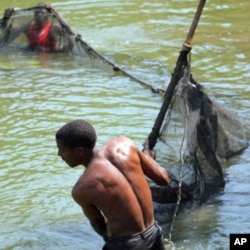
Industry experts predict that farmed fish output will increase 50 percent from current levels by 2030.
In the United States, which currently imports 84 percent of its seafood and produces less than 2 percent of the world’s cultivated fish - the Obama Administration has proposed new guidelines that would make it easier to set up fish farms in federal waters.
U.S. officials say expanding domestic aquaculture production will reduce pressure on wild ocean catch and cut the nation’s seafood imports.
While many environmental groups have expressed wariness about the rapid expansion of fish farming, the global aquaculture assessment released this week suggests that fish farming done well can be ecologically benign. Sebastian Troeng is a vice president at Conservation International, a co-sponsor of the report. He says among its key recommendations are increased innovation in aquaculture production, and better regulations in the part of the world where the sector is big and growing very rapidly.
Troeng adds that careful compliance with environmental regulations is also essential in reducing adverse impacts as the industry grows. “So we can understand where there is going to be a push to increase production and then help guide that production so that it doesn’t place unacceptable demands on the environment.”
Troeng says the challenge is to get public officials, agencies, industry and communities to work together with a set of common goals that address world food needs while also protecting the environment.