



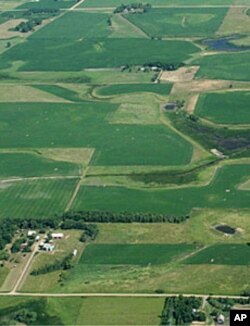
From the air, South Dakota looks like a patchwork quilt, as if someone neatly sectioned off the landscape with square and rectangular cookie cutters. This is corn and soybean country. So finding a 260 hectare plot of grass, called EcoSun Prairie Farm, on prime South Dakota farmland is very unusual.
Ecologist Carter Johnson of South Dakota State University admits that some people think EcoSun is a crazy idea, but adds optimistically, "Others think maybe these guys got something, maybe that's a good idea. The proof is in the pudding," he points out with a laugh, "and hopefully we'll produce some pudding one day and have some good results."
Eventually, he'd like to see prairie farms spring up all over eastern South Dakota to grow the state's native plants.
Successful farms don't have to harm the environment
Agriculture is an important part of the economy in the American Midwest. But intensive farming practices can be detrimental to the environment and measures to prevent or reduce pollution are often costly to farmers. Johnson thinks there's a better way, and this project is designed to prove it.
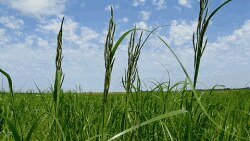
The ecologist's test fields are covered by two-meter tall switchgrass, cordgrass and blue stem grass which are mixed with wildflowers. The mix is as diverse as the revenue opportunities he expects they'll provide.
He gently tugs some seeds off the tip of switchgrass. Seeds like these are one income stream. Prairie grass is also selling well as livestock feed. This year, Johnson will add cattle to the landscape to raise grass-fed beef.
Since the fields here are not plowed, carbon held in the soil is not disturbed and released into the air. Some environmentalists suggest farmers should be paid to store the greenhouse gas in their fields, to offset emissions from industry and cars.
And if cellulose-based ethanol fuel becomes economically viable, that would also be a market the prairie farm could enter.
A win-win proposition
"It's a different way to look at grass than planting it and letting it sit," Johnson says. "Let's plant it and put it to work. And make some money off it, while we're also benefiting the environment. Sounds like a win, win deal to me."
Capital investment is much lower here, than on a traditional farm because there's no need for costly equipment like tractors and combines - or fuel to run them. To sum up the environmental benefits: more carbon is held in the ground, runoff from the fields is reduced and what's grown here can be used for renewable fuels.
Using prairie grasses to repair damaged wetlands
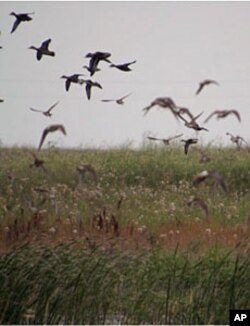
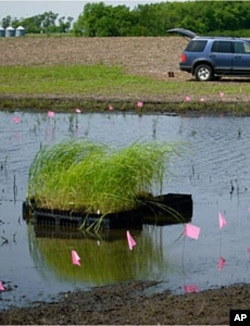
Some of the plants, such as cordgrass, can also help restore wetlands. Boggy marshes protect and improve water quality, provide fish and wildlife habitats and reduce flood risk. But boggy marshes have been shrinking due to climate change and the practice of draining them to increase the amount of crop land. The seeds from prairie cord grass can be sold to replant wetlands, re-establishing an important habitat for birds, insects, plants and other prairie creatures.
Waiting for the pudding
At a typical South Dakota corn and soybean farm, second-generation crop farmer Larry Birgen likes the idea of being more environmentally friendly, and not needing costly equipment like combines. But before Birgen converts any of his prime crop land, he says he needs to know that prairie farms can make money. "If they get to the point where they can show it's economically feasible, I would definitely consider it," Birgen says.
Johnson hopes to get to that point in a few years, showing that a prairie grass farm is a money maker, without government subsidies and inspiring farmers to find creative ways to put environmental stewardship on a par with economic needs.