



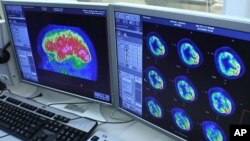
Stem cells taken from a patient’s own body fat may one day be used to treat a deadly brain cancer, based on some promising but still preliminary research.
The brain tumor known as glioblastoma occurs mostly in men, and most patients don’t live much more than a year after being diagnosed.
Most of the cancer can be removed by surgery, “but unfortunately we just can’t cure the cancer, and we have to rely on other techniques to be able to do it,” says Johns Hopkins University neurosurgeon Alfredo Quiñones-Hinojosa.
He and his colleagues are trying to improve a treatment aimed at the cancer cells left behind after most of the tumor is cut away in surgery.
In recent years, doctors have focused on a kind of adult stem cell called mesenchymal stem cells, which are drawn to these cancer cells.
“They can track those cells that are migrating in the human brain, and they can actually deliver a treatment. We can use them as Trojan horses,” Quiñones said.
The mesenchymal stem cells now used on patients come from donor bone marrow. Quiñones’ new idea is to get them from the patient’s own fat tissue, a procedure which is cheaper and less invasive, and also avoids the risk of rejection.
In laboratory tests, as he reports in PLOS ONE, the results seem promising, even though he admits it’s not exactly clear how these stem cells seek out the cancer cells. But once they reach the cancer, they can target the disease in two ways.
“They seem to secrete something that makes these tumors less aggressive already. And then we couple that with the ability to genetically engineer them to deliver a treatment that we know that can be effective on brain cancer.”
Alfredo Quiñones and his colleagues have begun experiments with animals, but he says it will be three to five years before human trials begin.
The brain tumor known as glioblastoma occurs mostly in men, and most patients don’t live much more than a year after being diagnosed.
Most of the cancer can be removed by surgery, “but unfortunately we just can’t cure the cancer, and we have to rely on other techniques to be able to do it,” says Johns Hopkins University neurosurgeon Alfredo Quiñones-Hinojosa.
He and his colleagues are trying to improve a treatment aimed at the cancer cells left behind after most of the tumor is cut away in surgery.
In recent years, doctors have focused on a kind of adult stem cell called mesenchymal stem cells, which are drawn to these cancer cells.
“They can track those cells that are migrating in the human brain, and they can actually deliver a treatment. We can use them as Trojan horses,” Quiñones said.
The mesenchymal stem cells now used on patients come from donor bone marrow. Quiñones’ new idea is to get them from the patient’s own fat tissue, a procedure which is cheaper and less invasive, and also avoids the risk of rejection.
In laboratory tests, as he reports in PLOS ONE, the results seem promising, even though he admits it’s not exactly clear how these stem cells seek out the cancer cells. But once they reach the cancer, they can target the disease in two ways.
“They seem to secrete something that makes these tumors less aggressive already. And then we couple that with the ability to genetically engineer them to deliver a treatment that we know that can be effective on brain cancer.”
Alfredo Quiñones and his colleagues have begun experiments with animals, but he says it will be three to five years before human trials begin.