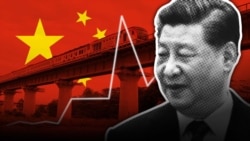



Less than a week before South Korea hosts the Group of 20 economic summit, Asian governments are preparing to counter a new effort by the U.S. Federal Reserve to boost the American economy. One of President Barack Obama's top economic advisers is not certain how much the Fed's move will help.
Financial officials in Beijing, Seoul and other countries are reacting harshly to the U.S. Federal Reserve's plan to pour more dollars into the economy.
Asian countries worry the Fed's move will send a wave of cheap dollars to the region, driving up the value of their currencies, and dangerously inflating property and stock prices.
And, some economists in the region say, it may not do much to help the stagnant U.S. economy.
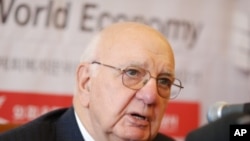
In a speech and remarks to reporters in Seoul Friday, even the chairman of President Obama's economic recovery advisory board, Paul Volcker, was less than optimistic about the Fed's move.
"The object of the exercise is obviously to provide some support for the American economy. I don't think that will be very large. That doesn't say there won't be any. And there are certainly hopes there will be some. But I don't think that action alone will make a very dramatic difference," said Volcker.
The former Fed chairman was speaking less than a week before the South Korean capital hosts political leaders at the Group of 20 summit. The meeting is supposed to find common ground to power a global economic recovery and reduce international financial and trade imbalances.
But there are growing signs the 20 leading economies may not achieve that goal. Thai officials are raising the possibility of Asia policy makers uniting to combat an expected flood of dollars as investors look to the region for better returns as a result of the U.S. move.
China, the number two economy behind the United States, on Friday expressed concerns about the Fed's move.
Vice Foreign Minister Cui Tiankai spoke at a briefing in Beijing on the G20 summit.
He says Washington owes other countries an explanation of the Fed's move, and that he has seen considerable concern about its effect on other countries. Cui goes on to say that as the main issuer of a reserve currency, the United States needs to take a responsible position.
Cui also rejected an idea, apparently supported by Washington and Seoul, for the G20 leaders to set specific targets for trade deficits.
The currency issue threatens to overshadow other agenda items at the G20 meeting, much to the consternation of host South Korea. But that has not prevented the Finance Ministry here from warning the Fed's action could force Seoul to take steps to limit incoming dollars, such as taxing foreigners who invest in South Korean treasury bills.
The Bank of Japan on Friday decided to keep at virtually zero a key interest rate. The Japanese central bank hopes this will foster a long-sought recovery for the world's third largest economy.
Fed Easing Prompts Further Currency Concern, Skepticism in Asia