


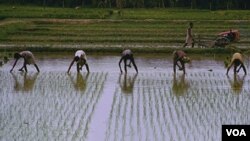
Decades after the Green Revolution took place in many parts of the world, food shortages, high prices, hunger and poverty are major problems. It’s estimated there are about one billion chronically hungry people. Now, a new book poses the question – can we feed the world?
Sir Gordon Conway is the author of One Billion Hungry. He says the answer to the question – can we feed the world? – is yes, but a qualified yes.
“We can feed the world if we focus our efforts. If we provide sufficient aid and investment. If we utilize new technologies. If we create fair and efficient markets. If we really utilize the power of women as farmers and as mothers as nutritionists, as it were, and if we tackle climate change,” he said.
Conway described hunger as not having enough food of the right nutritious quality to lead a reasonable active life.
However, he added, “It varies of course in terms of whether you’re a man or a woman, whether you’re old or young. I think the worst hunger is child malnutrition. We’ve got about 170 / 180 million children in the world under the age of five who are stunted in their growth. In other words, they’re below the height they ought to be for their age. And that comes about because they don’t get enough micronutrients. They don’t get enough Vitamin A. They don’t get enough zinc. They don’t get enough iron.”
The Green Revolution saw increased agricultural research and technology, much of which occurred in the late 1960s. The development of high yield crops, modern farming techniques, fertilizers and hybrid seeds have been credited with helping to save the lives of over a billion people.
Conway said, “It was a success because it allowed food production to keep pace with population growth. And it was particularly successful in India and south Asia, generally. You have to realize that at the time of the Green Revolution India was highly dependent on shipments of grain from the United States. And they wanted to gain independence. So they wanted to be able to produce their own grain and that’s what the Green Revolution did for them.”
But it had its limitations.
“It only focused on the best lands in India. It was over-reliant on pesticides and fertilizers. Only some of the poor really benefitted. There were many poor who were left out, even in India and South Asia, generally. And of course it passed Africa by. So those were big limitations,” he said.
Conway calls for a new Doubly Green Revolution. A revolution that produces just as much food, but takes it a few steps further.
“To ensure that productivity goes to the poor and in particular that it doesn’t have a negative effect on the environment. So it’s green in two ways. It’s green because you’ve got fields of green wheat and rice and it’s green because it’s environmentally friendly,” he said.
During the Green revolution, the environment often took a back seat to productivity. Conway says there are “four routes” that should be pursued to ensure food security: innovation, markets, focusing on people and political leadership.
“If we take innovation first, what we’re trying to do there is to produce appropriate innovations -- innovations that bring about high productivity, but don’t have the side effects that maybe occurred in the past. And with markets, we want fair markets and efficient markets. With people, it’s particularly about engaging women, because a large number of farmers in Africa and the developing world as a whole are women. And political leadership – it’ll only work if leaders really focus on agricultural development and food security,” he said.
The Imperial College London professor said this also hinges on mitigating and adapting to the effects of climate change.
“If you take Africa, the prediction is by 2050 the growing seasons will have shortened by five percent. I was in northern Ghana last year and the growing season was very short. In other words, the rains came a month late and they finished a month early. Secondly, the temperatures are going up. In Africa, as the temperatures get above 30 degrees [Celsius] the maize crop begins to suffer,” he said.
Food security on the household, country and global levels becomes even more important as the world population grows. The U.N. estimates it will rise to more than nine billion by 2050. That’s about two billion more than we have now.
Conway’s book -- One Billion Hungry: Can We feed the World? --will be published October 9th.
Sir Gordon Conway is the author of One Billion Hungry. He says the answer to the question – can we feed the world? – is yes, but a qualified yes.
“We can feed the world if we focus our efforts. If we provide sufficient aid and investment. If we utilize new technologies. If we create fair and efficient markets. If we really utilize the power of women as farmers and as mothers as nutritionists, as it were, and if we tackle climate change,” he said.
Conway described hunger as not having enough food of the right nutritious quality to lead a reasonable active life.
However, he added, “It varies of course in terms of whether you’re a man or a woman, whether you’re old or young. I think the worst hunger is child malnutrition. We’ve got about 170 / 180 million children in the world under the age of five who are stunted in their growth. In other words, they’re below the height they ought to be for their age. And that comes about because they don’t get enough micronutrients. They don’t get enough Vitamin A. They don’t get enough zinc. They don’t get enough iron.”
The Green Revolution saw increased agricultural research and technology, much of which occurred in the late 1960s. The development of high yield crops, modern farming techniques, fertilizers and hybrid seeds have been credited with helping to save the lives of over a billion people.
Conway said, “It was a success because it allowed food production to keep pace with population growth. And it was particularly successful in India and south Asia, generally. You have to realize that at the time of the Green Revolution India was highly dependent on shipments of grain from the United States. And they wanted to gain independence. So they wanted to be able to produce their own grain and that’s what the Green Revolution did for them.”
But it had its limitations.
“It only focused on the best lands in India. It was over-reliant on pesticides and fertilizers. Only some of the poor really benefitted. There were many poor who were left out, even in India and South Asia, generally. And of course it passed Africa by. So those were big limitations,” he said.
Conway calls for a new Doubly Green Revolution. A revolution that produces just as much food, but takes it a few steps further.
“To ensure that productivity goes to the poor and in particular that it doesn’t have a negative effect on the environment. So it’s green in two ways. It’s green because you’ve got fields of green wheat and rice and it’s green because it’s environmentally friendly,” he said.
During the Green revolution, the environment often took a back seat to productivity. Conway says there are “four routes” that should be pursued to ensure food security: innovation, markets, focusing on people and political leadership.
“If we take innovation first, what we’re trying to do there is to produce appropriate innovations -- innovations that bring about high productivity, but don’t have the side effects that maybe occurred in the past. And with markets, we want fair markets and efficient markets. With people, it’s particularly about engaging women, because a large number of farmers in Africa and the developing world as a whole are women. And political leadership – it’ll only work if leaders really focus on agricultural development and food security,” he said.
The Imperial College London professor said this also hinges on mitigating and adapting to the effects of climate change.
“If you take Africa, the prediction is by 2050 the growing seasons will have shortened by five percent. I was in northern Ghana last year and the growing season was very short. In other words, the rains came a month late and they finished a month early. Secondly, the temperatures are going up. In Africa, as the temperatures get above 30 degrees [Celsius] the maize crop begins to suffer,” he said.
Food security on the household, country and global levels becomes even more important as the world population grows. The U.N. estimates it will rise to more than nine billion by 2050. That’s about two billion more than we have now.
Conway’s book -- One Billion Hungry: Can We feed the World? --will be published October 9th.