



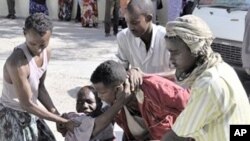
A pro-government militia and Islamist insurgents in Somalia both are claiming victory after nearly two days of heavy fighting in the capital, Mogadishu. The violence erupted after several bombings of mosques in areas of the country under the control of al-Qaida-linked militants.
Witnesses say the fighting began on Monday when al-Shabab fighters attacked pro-government Ahlu-Sunna Wal-Jama'a positions in the city. Al-Shabab reportedly launched the strike because it had received information that Ahlu-Sunna was preparing a raid on Bakara market, a busy open-air commercial area under the control of al-Shabab.
Bakara market is in a strategic area of Mogadishu and has been the base for Islamist insurgents since 2007. Al-Shabab frequently uses the market to fire mortars at African Union peacekeepers guarding the nearby presidential palace.
Al-Shabab's regional governor, Ali Mohamed Hussein, told reporters his group killed several Ahlu-Sunna fighters and won the battle. But the spokesman for the pro-government faction of Ahlu-Sunna Wal-Jama'a, Sheik Adirahman al-Qadi, says his forces are still dug in near Bakara market.
Al-Qadi says Ahlu-Sunna dealt al-Shabab a major blow by killing an Egyptian, who served as a senior al-Shabab military commander. Al-Qadi says many other al-Shabab fighters died in the fighting.
None of the claims on either side could be independently verified. But hospital workers say at least three civilians were killed and 15 others were wounded in the clash.
Ahlu-Sunna Wal-Jama'a is a diverse group made up of Sufi Muslims and various factional leaders who are fighting to retake Mogadishu and large areas of southern Somalia from the ultra-conservative, al-Qaida-linked al-Shabab. A faction of Ahlu-Sunna Wal-Jama'a recently signed a deal to back the U.N.-supported, but weak, Transitional Federal Government in Mogadishu.
A southern-based faction of another fundamentalist group called Hizbul Islam is also fighting al-Shabab. The two sides fell out last year over an administrative dispute in the southern port city of Kismayo.
Al-Shabab, which is considered a terrorist organization by several countries, has vowed to eliminate any group that challenges its power. Several-hundred foreign fighters, many trained in al-Qaida-run camps in Afghanistan, are believed to be among its ranks.
On Saturday, two powerful bombs exploded at a mosque in Bakara market, reportedly targeting a senior al-Shabab leader. Several days earlier, a landmine exploded in another mosque in an al-Shabab-controlled area of the capital. Two days ago, a third attack on a mosque took place in the al-Shabab-administered city of Kismayo.
No one has claimed responsibility for the attacks. But Somalis privately worry that with so many groups entering the battlefield, the two-decade conflict in Somalia might escalate.