



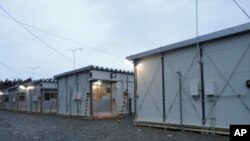
A month after the magnitude 9.0 earthquake and resulting tsunami devastated northeastern Japan, more than 125,000 people remain in evacuation centers.
Others are living with relatives.
Most of them were made homeless by the March 11 natural disaster while others were ordered from their residences around the crippled Fukushima-1 nuclear power plant.
A small number of families have just moved into temporary housing, but the majority of the homeless face an extended period in limbo.
As the rain-soaked ground shook again from a large aftershock, exactly one month after the disaster that made her family homeless, Mika Terui counts herself, her husband and three children as among the lucky ones. But, she says, she still has concerns.

Terui explains that while she is grateful to be living in new quarters rent free the family still has bills to pay. Her husband's job, along with their house and all of their possessions were washed away by the tsunami. Her husband has only been able to find part-time work at a gasoline station. So, now the 39-year-old housewife will also be looking for work.
The Teruis are one of the 36 families which, beginning Sunday, moved into temporary housing erected on the grounds of the Takada Number 1 Junior High School.
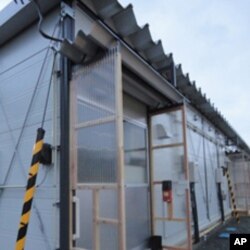
Each home has electricity, running water, a small bath and toilet, a microwave and a television set.
Prime Minister Naoto Kan, while on a visit to neighboring Miyagi prefecture Sunday, pledged to replicate on a vast scale what has been quickly accomplished in Rikuzentakata.
Mr. Kan told Miyagi officials that the central government intends to initially erect 70,000 temporary houses and will carry out construction of those homes as quickly as possible. The prime minister added that the government this week is convening a group of experts to draft the blueprint for the reconstruction effort.
After the visit, Miyagi Governor Yoshihiro Murai told reporters he asked the prime minister to provide adequate assistance for his constituents whom he says have been suffering greatly since the earthquake and tsunami a month ago.
The governor says he hopes that the livelihoods can be restored for those in the worst-hit areas, where fishing and agriculture are the main industries.
Japanese acknowledge their country has never faced such a setback in peace time as the disaster they have been confronted with since March 11. But many are growing impatient, even expressing anger, with the seemingly slow pace of the clean up and rebuilding effort.
The central government has announced no timetable for its reconstruction efforts and has been criticized for vague and sometimes contradictory statements, especially those involving the crisis at the nuclear power facility.
The plant has spewed radiation into the atmosphere and sea for much of the past month.
Some political analysts say that, in large part, explains the thrashing the governing Democratic Party took in local elections Sunday in other parts of the country.
The main opposition Liberal Democratic Party, which governed Japan for most of the post World War II era, has rebuffed Prime Minister Kan's repeated offers to form a grand coalition. That was seen as a way for the parties to temporarily put aside political difference and work together to expedite Japan's recovery from the worst event in its history since the Second World War.
Japanese officials say more than 13,000 people are confirmed dead with 14,000 still listed as missing.