



HONG KONG—Authorities in the Philippines recently seized a consignment of rhino horn, which they believe was being shipped through Manila to China.
Environmentalists say the find highlights how adept crime syndicates are at exploiting new routes to smuggle endangered wildlife from Africa into Asia, and how resilient they are when it comes to writing off losses and evading arrest.
According to Oliver Valiente, chief of the Philippines Customs Intelligence Investigation Service (CIIS), the consignment of horn was impounded at the Port of Manila in early September.
“This is the first time we have encountered rhinoceros horn," he said. "Six pieces were hidden in sacks of cashew nut."
Speaking by phone from Manila, where he and his team are investigating links to the illegal cargo, he says the seizure sets a disturbing new precedent. Concerned that the Philippines is becoming a new route in the global trade of endangered species, his groups is attempting to strengthen intelligence networks and gather information from counterparts in other countries.
"We hear there are Koreans, Chinese and other Asian [nationalities] buying rhino horn [in Manila's Chinatown]," he said. "There are stores here that suggest rhino horn is an aphrodisiac ... It is very, very lucrative.”
The six horns, valued at more than $1 million, are a significant catch — the majority of horns are typically believed to be smuggled into Asia one at a time in couriers’ suitcases.
CIIS suggests the consignment represents an exploratory effort by crime syndicates driving the rhino horn trade to open new smuggling routes from Africa into China, the world’s second-largest horn consumer after Vietnam.
According to Tom Milliken, director of the wildlife trade monitoring network Traffic, Beijing has recently intensified efforts to stop the smuggling of rhino horn, elephant ivory and parts from other endangered wildlife.
Although still fighting major contraventions, China has introduced new legislation to control online sales of rhino horn. Officials have also sent additional security forces to guard their border with Vietnam in an effort to control cross-frontier smuggling.
In a little-reported operation in April, 100,000 law enforcement officials deployed across the country, shutting down thousands of dealers in illegal wildlife. Meanwhile, Vietnam has not impounded a single rhino horn since 2008.
“China is targeting cargo from certain places in Africa," said Milliken. "Being able to move a container into the Philippines, change the documentation and make it appear as if it is coming from an Asian country has been a technique organized crime has used to try to safeguard their illicit cargo from detection.”
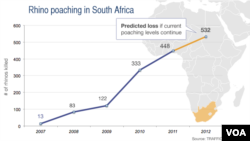
The Manila specimens, Milliken says, were likely removed from animals killed in South Africa, where authorities have worked hard to tackle rhino poaching despite considerable challenges.
Although South Africa has appointed attorneys who specialize in prosecuting rhino-related crimes and stiffened court sentences — convicted poachers and traffickers face up to 40 years in jail — their efforts are being undermined.
“Some Asian syndicates have shifted their operating bases to neighboring countries like Mozambique, where there is less chance of detection," said Milliken. "This is a worrying development … organized crime is very quick to adapt.”
Legal scholar Julie Ayling of Australia National University agrees. Last month she published a study on the resilience of organized crime syndicates behind the rhino horn trade.
In much the same way legitimate businesses factor in regulatory costs, says Ayling, so the gang behind the Manila shipment would have factored in the cost of customs agents intercepting the six horns.
“If the costs get too great, the crime group will reassess what they’re doing and adjust their business model," she said. "This could be a minor adjustment like changing a trafficking route or a major one involving a whole new way of doing business, or a whole new commodity. This is what I mean when I say criminal groups exhibit ‘resilience’.”
Ayling says governments and grassroots communities, public and private sectors, all need to work together to develop a coordinated response to fighting rhino crime.
But first and foremost, she believes, law enforcement agencies need to delve further into the structures of these criminal groups, if the rhino is to beat extinction.
“We need to understand these networks better," she said, explaining that they seem to spring into being. "It is amazing we do not have a good understanding of how they get together and form alliances — how they meet and form trust, how they actually operate in terms of their criminal activities.”
In South Africa, up to two rhino are believed to be killed by poachers each day, snared or shot and the horn hacked from the animal’s head while it is still alive.
