



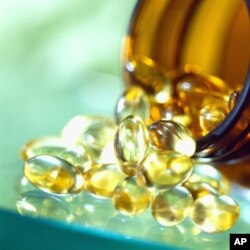
Fish oil supplements are a popular way to increase the intake of omega-3 fatty acids, which are thought to have a wide range of beneficial effects, particularly for cardiovascular health. But are they effective in preventing cancer? A new study suggests the answer is … maybe.
Women in the study — 35,000 of them — were asked in a questionnaire whether they used fish oil supplements. Six years later, those who did were much less likely to have had breast cancer.
"We found that women who were using fish oil at the time that they entered the study had a 32 percent lower risk of breast cancer than women who did not use fish oil supplements," said study leader Emily White of the Fred Hutchinson Cancer Research Center in Seattle.
She says there's good reason to suspect that omega-3 fatty acids might protect against cancer. "There's a strong evidence that cancer is related to inflammation. So fish oil fits into that mechanism, since it is an anti-inflammatory drug."
Despite the evidence, White doesn't think her study alone justifies a recommendation that women start taking fish oil capsules.
"No, I don't think that a single study can lead to public health recommendations to start taking supplements," she says. "Really, we need randomized trials, where people are assigned to take a supplement versus not, to answer whether a pill would be useful to take for cancer prevention."
White explained that in a randomized trial, participants would be randomly assigned to either take the supplements or not.
By contrast, her study is what is known as an observational study, where participants themselves decide, in this case, whether to take a fish oil supplement, and then the researchers observe them to see who develops cancer. But the women who chose to use a supplement could be different in many other ways from those who didn't.
White and her colleagues did try to factor those differences into their analysis, but scientists generally prefer a randomized study, and researchers at Harvard are now organizing one to study the effects of both omega-3 fatty acids and vitamin D.
White's paper is published in the journal Cancer Epidemiology, Biomarkers & Prevention.