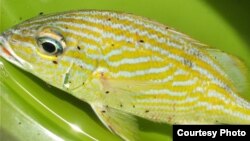
A Caribbean fish known as the French grunt that is infested with gnathiids, a blood-sucking parasite named after singer Bob Marley. (Credit: Elizabeth Brill)
Fish-Sucking Parasite Named After Bob Marley
A parasitic blood-sucking crustacean recently discovered in Caribbean waters off the Virgin Islands could advance our understanding of how disease is transmitted among marine animals, and may play a role in transmitting a malaria-like fish disease which weakens the animal’s immune system.
The new species is called Gnathia marleyi, named in honor of the late reggae star, Bob Marley.
Lead researcher Paul Sikkel, a marine biologist at Arkansas State University with a passion for Marley’s music, says the parasitic marleyi is the first new find in the crustacean-like gnathiid family in two decades.
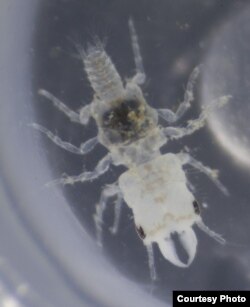
“What’s interesting about them is that they are only parasitic in the juvenile stage," Sikkel says. "They only feed when they are juveniles, and they go through three different juvenile stages, one bigger than the other and they look a little bit like ticks or fleas. They look very similar to terrestrial blood feeding organisms.”
Sikkel captured the juvenile marleyi at a so-called cleaning station. That’s a place on the reef where big fish gather so smaller fish and shrimp can nibble away at the parasites, including juvenile marleyi, that attach to the skin of big fish.
The tiny adult male marleyi, on which the new species description is based, don’t eat. They just mate and die. Sikkel followed the species through its life cycle in the lab.
As adults, male Gnathia marleyi don’t eat, they just mate and die. (Credit: John Artim)
“The adult males look a little bit like bulldozers," Sikkel says. "They have square heads. They have pincers on their head and they are very cool-looking. And the females have a small head and a really big body that’s full of eggs."
About 80 percent of all organisms found on coral reefs are parasites, with gnathiids among the most ecologically important. Sikkel says the concentration of gnathiids can be an indicator of how healthy a reef is. At some of his research sites, he is seeing fish more heavily covered with gnathiids - marleyi among them.
“Too many gnathiids hurt the fish and too little coral, we think, leads to more gnathiids," Sikkel says. "So in a nice, healthy coral rich environment, we don’t find many gnathiids, fish just get a few of them. But in areas where there isn’t too much live coral, there are more gnathiids and the fish get heavier loads on them.”
Sikkel suspects that Gnathia marleyi may also play a role in transmitting a malaria-like disease that weakens the fish's immune system. His team is currently studying whether this pathogen, found in gnathiids on other reefs, is also present in the Caribbean.
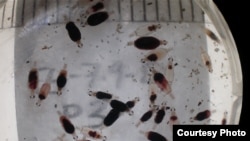
Juvenile gnathiids collected and observed in the laboratory after feeding on fish blood. (Credit: Ann Marie Coile)
“And then from there, once we find the species of fish that are affected, then we’ll do experiments to determine whether or not the gnathia marleyi actually plays a role in transmitting blood-born organisms.”
Sikkel hopes his discovery will shed new light on parasitic species like Gnathia marleyi and the impact they can have on marine ecosystems, which are already threatened by global warming, pollution and overfishing.