


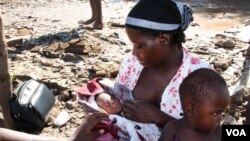
Torrential rains continue to cause flooding in large areas of Mozambique affecting 238,000 people and of those 186,000 have been forced to flee their homes for safety. Both the Zambezi and Limpopo rivers have burst their banks and humanitarian agencies are working in clusters to provide assistance and shelter to the homeless.
Dorothy Francis is an emergency expert of the International Federation of the Red Cross’s Disaster and Crisis team. She is helping to coordinate relief efforts for those displaced by the flooding in southern Mozambique and said the flooding is still concentrated in the Gaza Province.
Francis described the situation of the displaced as “living in the open, under trees and seeking refuge wherever they can. In addition to that we now have the rains beginning in central Mozambique in the Zambezia area. And here we have currently 33,000 people and the forecast is for more rain in the coming days. So it’s not getting better it seems to be getting worse.”
Francis said right now the Red Cross is conducting extensive water, sanitation and health activities. She explained, “we are providing more sanitation support in transit camps, in Chokwe in particular, where we are spraying to keep down the breeding of mosquitoes; helping with the construction of latrines; helping with the removal of waste and giving what we call hygiene promotion classes.” Francis said the classes help teach people how to keep their hands clean, how to handle food and how to take care of their children.
The Red Cross is also distributing mosquito nets because of the high rate of malaria in the country. “We’re doing epidemic surveillance and some epidemic control; watching the trends to see if we’re seeing higher incidences of malaria”, explained Francis who added “there have been some reports of cholera, which of course the government is unwilling to state. They’re still calling it water diarrhea. But it is cholera. It’s not a high incident. And again cholera is endemic so we’re not alarmed at incidences. It’s natural for this to happen in this sort of environment.”
Those that suffer the most of course are the most vulnerable, the female single head of the household; those with HIV/AIDS and tuberculosis; households headed by children, and the elderly. Francis said these groups of people are their priority for relief aid.
“We are going to be running a six month operation which will just focus on interventions and water health, and shelter. The government is doing the best they can. They have provided a large area for people to congregate. But there are no formal shelters that people can go to. So it’s pretty dire,” explained Francis.
Francis said humanitarian aid agencies are coordinating relief efforts in what they describe as a cluster system. The system allows each sector of of aid relief, whether it is a water and sanitation cluster; health; logistics; or shelter cluster, to all be coordinated from a central location. Francis explained this type of structure helps ensure that gaps are covered and there is no duplication of effort.
Dorothy Francis is an emergency expert of the International Federation of the Red Cross’s Disaster and Crisis team. She is helping to coordinate relief efforts for those displaced by the flooding in southern Mozambique and said the flooding is still concentrated in the Gaza Province.
Francis described the situation of the displaced as “living in the open, under trees and seeking refuge wherever they can. In addition to that we now have the rains beginning in central Mozambique in the Zambezia area. And here we have currently 33,000 people and the forecast is for more rain in the coming days. So it’s not getting better it seems to be getting worse.”
Francis said right now the Red Cross is conducting extensive water, sanitation and health activities. She explained, “we are providing more sanitation support in transit camps, in Chokwe in particular, where we are spraying to keep down the breeding of mosquitoes; helping with the construction of latrines; helping with the removal of waste and giving what we call hygiene promotion classes.” Francis said the classes help teach people how to keep their hands clean, how to handle food and how to take care of their children.
The Red Cross is also distributing mosquito nets because of the high rate of malaria in the country. “We’re doing epidemic surveillance and some epidemic control; watching the trends to see if we’re seeing higher incidences of malaria”, explained Francis who added “there have been some reports of cholera, which of course the government is unwilling to state. They’re still calling it water diarrhea. But it is cholera. It’s not a high incident. And again cholera is endemic so we’re not alarmed at incidences. It’s natural for this to happen in this sort of environment.”
Those that suffer the most of course are the most vulnerable, the female single head of the household; those with HIV/AIDS and tuberculosis; households headed by children, and the elderly. Francis said these groups of people are their priority for relief aid.
“We are going to be running a six month operation which will just focus on interventions and water health, and shelter. The government is doing the best they can. They have provided a large area for people to congregate. But there are no formal shelters that people can go to. So it’s pretty dire,” explained Francis.
Francis said humanitarian aid agencies are coordinating relief efforts in what they describe as a cluster system. The system allows each sector of of aid relief, whether it is a water and sanitation cluster; health; logistics; or shelter cluster, to all be coordinated from a central location. Francis explained this type of structure helps ensure that gaps are covered and there is no duplication of effort.