



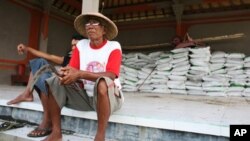
Massive flooding in Thailand and elsewhere has destroyed large parcels of rice farmland, opening the possibility of higher rice prices and leaving Southeast Asia at greater risk of a food price shock.
Heavy rains and massive flooding have destroyed crop land in Thailand, Cambodia, Vietnam and the Philippines.
The United Nations says it is closely monitoring the potential for “serious food shortages” in several parts of Southeast Asia after floods affected agricultural activities and aid deliveries.
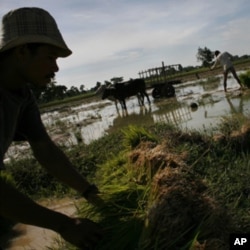
The U.N. Food and Agriculture Organization's (FAO) Global Information and Early Warning System, in a report released on Oct 21, says although no precise figures are available, continuous rain and flooding is estimated to have damaged at least 1.6 million hectares of standing crop in Thailand, representing more than 12 percent of total national cropped area. Another 12 percent of the total area under paddy in Cambodia is also believed to have been damaged.
About six percent of rice farmland is damaged in the Philippines, while in Vietnam it is reported that as much as 7.5 percent of the farmland is destroyed.
Yang Razali Kassim, a senior fellow and analyst at the S. Rajaratnam School of International Studies of Nanyang Technological University in Singapore, says food security in Southeast Asia will certainly be affected by the floods in the region.
“The scale of the floods is unprecedented, and therefore, the threat on regional food security is also unprecedented. Rice supplies to the region is bound to be affected, adding to the pressure on food prices that have already seen rises in recent times due to shortages caused by erratic weather,” he said.
Before the floods, said to be Thailand’s worst in the last 50 years, the Bangkok government forecast rice production to stand at 25.8 million tons. But, the government predicts it may lose some six million tons of rough-rice from flooding. Analysts say Thailand, which accounts for 30 percent of global rice exports, has already lost three million tons of rice due to floods.
The price of rice is hovering at about $650 per ton currently, but rice traders are expecting the price to increase to $750 per ton, inching closer to its record-high level of $1,000 per ton in 2008.
However, many Asian countries control rice prices via government subsidies, making it unlikely that price hikes will hit most consumers in the near term.
Kamal Malhotra, U.N. Resident Representative for Malaysia, Singapore and Brunei Darussalam, said rice farmers living below the poverty line are among the most vulnerable to the impact of the floods, as they are likely to have the least bargaining power, least resources to organize themselves collectively and are more likely to sit at the lowest end of the production chain.
“Whether price increase[s] will result in income increase[s] for the majority of those involved in rice production varies, subject to how the production chain is structured and the relative bargaining powers between farmers, distributors and retailers,” he said.
Malhotra said that while floods and other climatic conditions may cause price increases, the current prices of rice and other food commodities are also partly cost-pushed due to a fuel price hike and also the ongoing policy to replace food crops with cash crops.
“Without reversing some of these policies, food prices will be extremely volatile to short-term ‘shocks’ such as floods, subsequently affecting food security,” he said.
He added that shortages in food supplies are exacerbated by the possibility of panic-driven protectionism that may also push up prices.
In 2008, a global food price shock mainly driven by rising oil prices caused political and social unrest in several poor and developed countries. A World Bank report released on February 15 said continuously rising food prices have pushed another 44 million people into extreme poverty and exposed them more to hunger.
The floods that hit Southeast Asia have not only destroyed crops and livestock, but also claimed hundreds of lives and displaced thousands of people.