For Moira Smiley, Global Music Journey Transcends Time
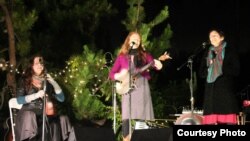
VOCO live at the Polish Plantation, Los Angeles, CA (Photo: Simone McSparran)
LOS ANGELES – Moira Smileyand the vocal group VOCO have performed all over the world. The women sing folk music that celebrates everyday life, steeped in generations of tradition, from far-off, tucked-away corners of the globe. Places where songs are passed down, learned by heart, rather than written down.
To hear VOCO is to be transported across waters, across worlds, across time.
“What I love about old music, is that there is a sense of your smallness in the big story," Smiley explains, "and that your song is about reaching out into the unknown with your voice as a searchlight.
April Guthrie, Moira Smiley, Sally Dworsky (Photo courtesy Moira Smiley)
Smiley, VOCO’s main composer, arranger and musicologist, started exploring the world’s music as a little girl. She grew up in a farmhouse in Vermont where her parents had a big wooden chest, filled with records.
“From an early age, I wanted to organize them, and sort of understand the differences between these different styles that my parents liked," she recalls. "They were interested in classical music and art music and folk music. Basically, they were wanting to understand the world through music.”
Understanding the world through music became Smiley’s lifelong passion as well. When she was 12, she toured Europe with a folk music group, and was captivated by the music she heard there. After college, she continued her travels - to Russian villages, Irish pubs, Appalachian hollows, all to listen, learn and absorb songs that have been sung for generations, in places where music is woven into everyday life.
“It tends to have been the places that are not cities, they’re rural and people don’t think of themselves as musicians," Smiley explains, "and they would laugh if you said they were, but then they come up with 50 songs that they know by heart.”
In Ireland, she studied traditional Sean Nós (unaccompanied singing) mastering the vocal subtleties she calls the ‘ornaments.’ She compares it to learning the accents of a language.
Early on, Smiley was drawn to the folk music and harmonies of Eastern Europe - Croatia, Bosnia, Serbia, Bulgaria.
“Mostly the songs that the women would sing and songs to accompany dance," she elaborates. "And they were full of harmony, at least two-, often three- and four-part vocal harmony.”
Smiley brought home the music she learned, taught it to her friends, and VOCO was born.
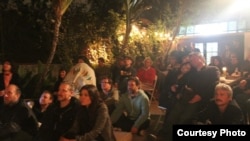
Listeners enjoying a backyard house concert at the Polish Plantation (Photo: Simone McSparran)
Since then, the group - with a revolving cast of singers - has performed on international stages, at folk festivals, and under moonlit skies like this one, at a backyard house concert in Los Angeles. The voices may vary, but the experience is always magical.
Although at times, the voices of VOCO blend with the usual urban soundscape: barking dogs, distant freeways, even a little Ranchera radio bleeding through the speakers - they can still take us to a place where songs like these have been sung for centuries. And where the things that are sung about never change.
"Love, love, wretched love, why do you not blossom on every tree, and why do you not come for every boy, every lonely girl and every orphan boy," Smiley declares during a performance. "This is from Hungary," she adds, explaining the origin of the song they are about to hear.
Moira Smiley continues to search for the musical bridges that cross oceans - and generations. And to build them.