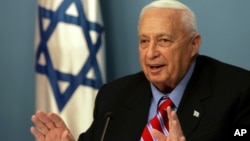
Seven years after suffering a massive stroke comatose ex- Israeli prime minister Ariel Sharon has surprised his doctors by displaying "a certain degree of consciousness," an expert who examined him using an MRI scan said on Sunday.
The results of tests conducted by a joint Israeli-American team did not mean the former general and right-wing politician turned peacemaker was about to wake up from the coma he has been in since a January 2006 stroke.
But doctors saw the responses displayed by Sharon, 84, in a two-hour exam on Thursday as ``encouraging'' that there may some day be a cure for some comas, Alon Friedman, a neurological director at Israel's Soroka Medical Centre in Beersheba, said.
Experts at Soroka, joined by a leading U.S. neurologist, Martin Monti, of the University of California Los Angeles, scanned Sharon's brain to test its function Friedman told Reuters in an interview by telephone.
"The chances of him getting out of bed are very, very slim," Friedman said.
But the machine detected some brain activity, when Sharon was shown photographs of his family and also when asked to imagine his home, he said.
These findings suggest that despite Sharon's comatose state "he might be listening, and some important information goes into his brain and is being processed," Friedman said.
Sharon "might be awake, and there is a chance that he is conscious," though due to paralysis suffered as a result of his stroke he cannot respond physically, he added.
"To some extent the patient is what we call 'locked in', he understands and responds with his brain but cannot activate any muscles."
Friedman said Sharon's eyes were open for at least part of the time when he responded to the sight of family photographs.
More surprising were signs the machine showed that Sharon had processed a request to imagine various scenes such as his home, Friedman said, adding that Sharon's brain had also shown signs of responding to his son, Gilad's voice.
"The results of the tests are not clear but encouraging, and they surprised us," Friedman said, adding he saw the results as contributing to data about potential stimuli scientists hope may someday help them awaken certain patients from a coma.
"This is futuristic, and not the case at the moment," he said.
Sharon's stroke felled him at a critical juncture in Israeli politics.
Once a hard-line defence chief, Sharon made a dramatic political about-face with a 2005 Gaza pullout. His illness came just weeks after he made a dramatic exit from the right-wing Likud party to found a centrist faction in the hope of advancing peace moves with the Palestinians.