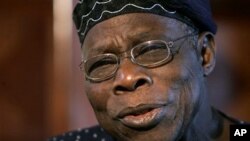



In an effort to diffuse the tense situation in the Ivory Coast, former Nigerian President Olusegun Obasanjo met with both incumbent President Laurent Gbagbo and former prime minister Alassane Ouattara in what he called a "process of exploration." He told reporters in Abidjan that he is optimistic about the process, but will not rule out force to remove Mr. Gbagbo.
"When you have a problem you must consider all possible solutions and you must adopt the most realistic, the most effective, the most cost-effective solutions," Mr. Obasanjo said.
Mr. Obasanjo was here as part of a mediation effort by West African leaders who are considering a regional military force against Mr. Gbagbo if he does not hand power over to Mr. Ouattara, who is the internationally-recognized winner of November's vote.
But the unanimity of that regional approach has been undermined by Ghana's president, John Atta Mills, who is refusing to take sides in the crisis and says he will not contribute troops to a regional force because he does not believe a military operation will work.
"It is not for Ghana to choose a leader for Cote D'Ivoire, but Ghana should support any measures to implement the democratic ideals that we all cherish," Mills said.
The president says Ghana's forces are already over-stretched and taking part in a regional force could endanger the lives of Ghanaian civilians living in Ivory Coast.
"As a person I do not think that this military operation is going to bring peace to Cote D'Ivoire, indeed my oath to the people of Ghana is to protect our territorial integrity and the safety of Ghanaians," Mills said.
Gbagbo militants are already threatening to attack civilians from any nation that contributes to a regional force. The Gbagbo government authorized a small demonstration Sunday by regional expatriates who oppose military intervention.
With Mr. Ouattara secluded in a resort hotel guarded by U.N. peacekeepers, Mr. Gbagbo appears determined to prolong this crisis as long as possible in hopes of weakening near-unanimous international support for his rival. Ghana's president breaking with the regional threat of force indicates that strategy may be working.
Mr. Ouattara's foreign minister, Jean-Marie Kacou Gervais, says he is not concerned by President Mills' stand because Ghana is already part of the U.N. mission here.
"The president of Ghana said so because he already has people in the U.N. mission in Cote d'Ivoire, so it would be difficult for him to bring in more people," Gervais said. "He is already involved."
Gervais says Ghana's reluctance does not affect ECOWAS planning for military action, a push that is being led by Nigerian President Goodluck Jonathan.
"We will soon know that ECOWAS is quite involved and I am sure President Jonathan Goodluck is working on it very hard. We know that a lot of heads of state of ECOWAS are working on the issue, and we are quite confident," he said. "No change at all."
Ouattara officials say Mr. Obasanjo reinforced the ECOWAS position that Mr. Gbagbo must leave office or risk being forced from power.
Former Nigerian President Optimistic About Ivory Coast Mediation