



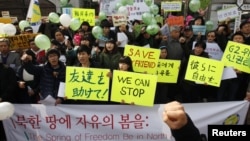
SEOUL - South Korea's foreign ministry says China has been holding four of its citizens in Dandong, activists linked to North Korean refugees, since their arrest March 29 in Dalian.
Spokesman Cho Byung-je says Seoul is asking Beijing to handle the case in a fair and swift manner.
"South Korea understands that the investigation is proceeding based on procedures under Chinese law," said Cho, who did not comment on specific accusations because formal charges have yet to be levied.
The group appears to have been in contact with North Korean refugees in northeastern China to find about life and conditions in their homeland.
Seoul-based activists said at least one of the detained men, Kim Young-hwan, a prominent and controversial figure in human rights circles in South Korea, is likely to face spying charges.
Kim, an independent researcher with the Network for North Korean Democracy and Human Rights, known as NKnet, is best known for clandestinely boarding a North Korean submarine in 1991 in order to meet the country's founder, Kim Il Sung. He later renounced his support for Pyongyang's ideology and became a strong critic of the reclusive country's human rights abuses.
The other South Korean detainees are identified as Yu Jae Gil, Kang Shin Sam and Lee Sang Yong.
Park Jin-keol, director of NKnet's international department, said South Koreans who assist North Koreans in China do face danger, but that they are rarely arrested for spying.
"In other cases, usually these people are not charged with espionage," he said. "Based on what Mr. Kim has been writing in South Korea, he never argued against the Chinese government. He only advocated human rights and the well-being of North Koreans. So we suspect that North Korean spy agencies or authorities are deeply involved in this incident by charging Mr. Kim and other people [in China] for espionage.”
South Korea's foreign ministry said one of its diplomats was able to meet Kim on April 26, but that Chinese officials said the other three men declined to meet with anyone from the consulate.
Park said he doesn't believe the latter statement.
"It's very unusual and it does not make whole sense to refuse meeting with consul," he said. "So we suspect this information is fabricated or not true."
When asked about the situation after it had been widely reported in South Korea, China's foreign ministry spokesman Hong Lei pleaded a lack of knowledge and said he needed to get details before responding.
South Koreans, especially Christian missionaries, frequently seek to help tens of thousands of North Koreans believed to be residing in China. While some are attempting to make their way to a third country with the hopes of then defecting to South Korea, many others are in hiding and trying to make money.
If caught, North Koreans are usually forcibly repatriated as economic migrants, a process rights groups oppose on allegations that they face harsh treatment upon returning home.
Spokesman Cho Byung-je says Seoul is asking Beijing to handle the case in a fair and swift manner.
"South Korea understands that the investigation is proceeding based on procedures under Chinese law," said Cho, who did not comment on specific accusations because formal charges have yet to be levied.
The group appears to have been in contact with North Korean refugees in northeastern China to find about life and conditions in their homeland.
Seoul-based activists said at least one of the detained men, Kim Young-hwan, a prominent and controversial figure in human rights circles in South Korea, is likely to face spying charges.
Kim, an independent researcher with the Network for North Korean Democracy and Human Rights, known as NKnet, is best known for clandestinely boarding a North Korean submarine in 1991 in order to meet the country's founder, Kim Il Sung. He later renounced his support for Pyongyang's ideology and became a strong critic of the reclusive country's human rights abuses.
The other South Korean detainees are identified as Yu Jae Gil, Kang Shin Sam and Lee Sang Yong.
Park Jin-keol, director of NKnet's international department, said South Koreans who assist North Koreans in China do face danger, but that they are rarely arrested for spying.
"In other cases, usually these people are not charged with espionage," he said. "Based on what Mr. Kim has been writing in South Korea, he never argued against the Chinese government. He only advocated human rights and the well-being of North Koreans. So we suspect that North Korean spy agencies or authorities are deeply involved in this incident by charging Mr. Kim and other people [in China] for espionage.”
South Korea's foreign ministry said one of its diplomats was able to meet Kim on April 26, but that Chinese officials said the other three men declined to meet with anyone from the consulate.
Park said he doesn't believe the latter statement.
"It's very unusual and it does not make whole sense to refuse meeting with consul," he said. "So we suspect this information is fabricated or not true."
When asked about the situation after it had been widely reported in South Korea, China's foreign ministry spokesman Hong Lei pleaded a lack of knowledge and said he needed to get details before responding.
South Koreans, especially Christian missionaries, frequently seek to help tens of thousands of North Koreans believed to be residing in China. While some are attempting to make their way to a third country with the hopes of then defecting to South Korea, many others are in hiding and trying to make money.
If caught, North Koreans are usually forcibly repatriated as economic migrants, a process rights groups oppose on allegations that they face harsh treatment upon returning home.