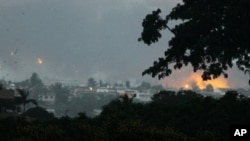
French troops and United Nations peacekeepers are joining the fight against Ivory Coast's incumbent president as forces backing the country's internationally recognized leader launch another attack for control of the commercial capital, Abidjan.
United Nations and French helicopters in Abidjan have fired on forces loyal to incumbent President Laurent Gbagbo to stop them from using heavy weapons. A spokesman for the U.N. mission in Ivory Coast says helicopters fired on Gbagbo's troops at the main military barracks as well as the presidential palace and Gbagbo's residence.
French President Nicolas Sarkozy ordered French forces to join U.N. operations to protect civilians and remove Gbagbo's heavy artillery.
U.N. Secretary General Ban Ki-moon asked President Sarkozy for what he called "urgent" military operations to silence mortars and rocket launchers that have been used against civilians and U.N. headquarters in Abidjan.
Gbagbo's supporters say the U.N. and French intervention amounts to an assassination attempt against their leader. In a written statement, Ban said the military operation does not mean the United Nations is taking up arms against the incumbent president. He said it is in line with the mission's Security Council mandate to take action to defend itself and protect civilians.
Laurent Gbagbo's state-run television reported the attacks in a crawl across the bottom of the screen, but it did not carry its regular evening news. Instead it broadcast a patriotic ode to the country.
The U.N. and French intervention comes on the fifth day of fighting in Abidjan as forces backing the internationally recognized President Alassane Ouattara launched another offensive to drive Gbagbo from power. They entered Abidjan on Thursday and fought much of Friday and Saturday to capture the presidential palace and Gbagbo's residence.
Regional diplomats say that offensive fell short, in part, because of the mortars and heavy artillery used by soldiers still loyal to Gbagbo. Those troops have held out against pro-Ouattara fighters and are calling for reinforcements to, in their words, "defend Ivorian sovereignty against mercenaries and U.N. peacekeepers."
The fighting in Abidjan has led to a shortage of food and fuel. And U.N. Humanitarian Affairs Officer Carlos Geha says civilians caught in the crossfire have had trouble getting medical assistance.
"Access to health centers is nearly impossible and there are no protection on the streets in Abidjan at the moment," Geha. "And it is very difficult for anyone to go to the hospital. Most of the hospitals are also without doctors and they have no oxygen and they have no food for the patients, and we are unable to reach them at the moment."
Gbagbo's claim to the presidency is based on the constitutional council annulling as fraudulent nearly 10 percent of the ballots cast in November's run-off election. Outarra's claim to the presidency is based on electoral commission results certified by the United Nations.
The West African regional alliance, the African Union, the United Nations, the European Union and the United States are calling on Gbagbo to step down immediately, so Ouattara can take office.
French, UN Forces Join Fight Against Incumbent Ivory Coast President