Violence Flares as Syrian Opposition Garners Support
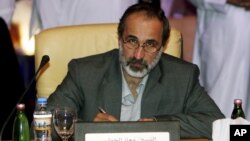
Cleric Ahmad al-Khatib was chosen in Doha, Qatar to lead newly united opposition against Syrian's president, Bashar al-Assad, November 11, 2012.
CAIRO —
Deadly fighting continues in Syria, as Arab and European leaders urge the newly-united opposition to seek broader support after it was recognized by the six-nation Gulf Cooperation Council.
It was a day of partial victories for the new Syrian opposition front, as European and Arab foreign ministers discussed levels of recognition by foreign states and regional groups.
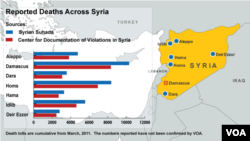
Reported Deaths Across Syria - updated Nov 5, 2012
Qatar's Foreign Minister Sheikh Hamid bin Jaber bin Jassem Al Thani urged international support. He called on international and regional groups to recognize the new entity as the legitimate expression of the expectations of the Syrian people, but stopped short of calling for it to be their sole representative.
Arab League foreign ministers gave the new coalition partial recognition, but did not go so far as to delegitimize the embattled government of Syrian President Bashar al-Assad.
Arab media reported that Algerian, Iraqi and Lebanese foreign ministers refused to endorse such a move.
British Foreign Secretary William Hague called the formation of the new group a "milestone," but insisted that strong internal support was needed before Britain would recognize it.
Profiles of three leaders of newly-founded Syrian National Coalition for Revolutionary Forces and Syrian Opposition:
Profiles of three leaders of newly-founded Syrian National Coalition for Revolutionary Forces and Syrian Opposition:
Ahmad Maath Khatib
Khatib is the president of the coalition. He is a 52-year-old political activist and a former cleric at the Great Mosque of Damascus, Islam's fourth holiest site. Khatib is regarded as a religious moderate and a political independent, even after spending four years working for the government-owned oil company. Khatib has been jailed four times for taking part in demonstrations against President Bashar al-Asad. He fled for Cairo with his family in April.
Riad Seif
Syrian opposition members elected Seif as Khatib's deputy. He is 65-years-old and ran an Adidas sportswear store in Syria before Syrian authorities imprisoned him and forced him into bankruptcy for his pro-opposition activities. When Mr. Assad became president in 2000, Seif founded the Damascus Declaration, a movement calling for more liberalized political institutions. He also founded a political party to challenge the ruling Ba'ath Party. Seif fled to Amman last year.
Suhair Atassi
A human rights activist, Atassi is one of the few women among the opposition leadership. She runs the Jamal Atassi Forum, a Facebook group calling for political reforms and the restoration of the civil and constitutional rights suspended since 1963. Atassi has been frequently harassed and threatened by Syrian security forces who demand she shut down her forum.
"We do now want to see the detail of the agreement that was made in Doha implemented and we want to see, in practice, that the Syrian opposition, that the coalition that has now been assembled, is as inclusive as possible of opposition groups and of all communities in Syria, and we want to see that they have support inside Syria," Hague said.
Hague and French Foreign Minister Laurent Fabius said their countries would continue to abide by a European Union arms embargo on Syria, which prevents them from arming rebel forces. Fabius, however, stated that France would recognize the new coalition.
Opposition seeks legitimacy
The head of the new Syrian opposition front, Maath al-Khatib, urged the EU to recognize the body by providing both political and financial support.
George Sabra, one of Khatib's deputies, has said repeatedly that the rebels need weapons more than anything else. The regime, he said, is armed, but its victims are not.
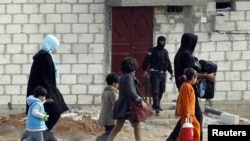
Meanwhile, Syrian government warplanes bombed the border town Ras al-Ein for another day Tuesday, causing more casualties and creating panic. Government planes also carried out aerial bombardment of parts of the capital Damascus and its outer suburbs.
Riad Kahwaji, who heads the Institute for Near East and Gulf Military Analysis, said that the government's bombing of the capital reflects its growing level of desperation, something the government denies is happening.
"This reflects the desperate position the regime has reached," he said. "The only reason that the Syrian regime is still in the fight is because of the money and the support it has been receiving from Iran and some manpower from Hezbollah. If it wasn't for the Iranian financing, the regime would have collapsed a long time ago."
No-fly zone debated
Kahwaji said the rebels have been making slow but steady progress in capturing portions of Syria from the government, but that it has taken a human toll. He said a no-fly zone, which is being considered by the U.S. and its NATO allies, would cut down civilian losses and hasten the fall of the government.
"Deploying Patriots along the borders will establish a no-fly zone up to about fifty to sixty kilometers deep into Syria," he said. "This would cover most of the provinces of Aleppo, Idlib and good chunks of Raqqa and Latakiya. Just the Patriots along the borders will create a no-fly zone for northern Syria."
People from the northern Syrian town of Ras al-Ain attempt to cross into Turkey, as a Free Syrian Army fighter leaves a home in the background, as seen from the Turkish border town of Ceylanpinar, Sanliurfa province, November 13, 2012.
Crisis worsening
Humanitarian groups reported Monday that the crisis is worsening for Syrians.
The Syrian Arab Red Crescent estimates that 2.5 million people inside Syria have fled their homes and are in need of humanitarian assistance.
United Nations refugee spokeswoman Melissa Fleming said five percent of them are living in schools and other public places. The rest are living with families.
"We have so many accounts from refugees who have come across borders who were previously internally displaced," she said. "They were internally displaced several times before they became refugees."
The United Nations refugee agency has some 350 staff in Syria, working in Damascus, Aleppo and Hassakeh. Fleming said the UNHCR is trying to provide aid to up to 1.5-million people inside Syria by the end of the year.
Fleming said recent disruptions to operations due to insecurity are hampering these efforts. Over the past few weeks, she said the agency lost aid supplies due to shelling and other problems. In addition, a truck carrying 600 blankets was hijacked on its way to Adra, outside Damascus.
- Correspondent Lisa Schlein reported from Geneva.